
Casting light on backsheet degradation
A U.S. research team has discovered that backsheets are most affected by cracking and degradation on inner layers, as such areas tend to become more rigid. The scientists have also discovered that degradation is accelerated by chemicals descending from the solar cells’ EVA encapsulant to the backsheets themselves.

Taiwan’s URE signs 120 MW glass-glass bifacial module order
United Renewable Energy has signed a memorandum of understanding to supply project developer Ye Heng Power with 120 MW of its solar panels. It plans to start shipping the PV modules in the second half.
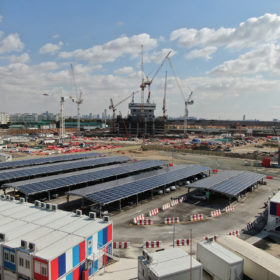
Solar for construction
Dubai-based PV developer Enerwhere has come up with a new business model for solar projects at construction sites. Its approach, which is based on short-duration PPAs, involves moving mobile PV installations from one building site to another.

Australian researchers push boundaries on tandem solar cells
Scientists at Australian National University have achieved a 27.7% efficiency rate for mechanically stacked perovskite-silicon tandem cells.

Duke Energy signs milestone power contract in North Carolina
Charlotte has become the first U.S. municipality to come to terms with Duke Energy on a solar contract through the new Green Source Advantage program.

Solar lobby group’s UK budget demands unlikely to be heeded
The UK Solar Trade Association has laid out its wish list ahead of new chancellor Rishi Sunak’s first budget speech tomorrow, with an exemption of solar from onerous tax valuations top of the agenda. COVID-19 measures, though, are likely to cast everything else into the shade.

Project developers can secure cash from new IRENA funding pot
The Climate Investment Platform launched by three multilateral bodies in September is now open for business and renewables companies in developing nations could qualify for help with clean energy facilities, renewables-related grid improvements and energy efficiency schemes.
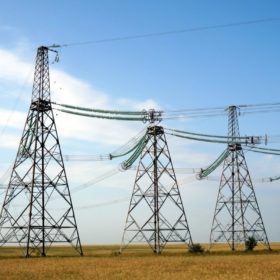
Entso-E targeted in recent cyberattack
The European Network of Transmission System Operators for Electricity said on Monday that unidentified hackers recently targeted its computer networks.

Restrictions on sourcing of cobalt are changing
The Democratic Republic of Congo (DRC) is one of the world’s most natural mineral rich countries, yet it is plagued with poverty, inequality, corruption, human rights violations and many more challenges. Mining for materials like cobalt is at the center of these. According to state-owned miner Gecamines, over 22% of the country’s GDP is generated in the mining sector, while 70% of the world’s cobalt is produced in the country.

Hanergy’s Solibro Hi-Tech unit in liquidation
With the opening of insolvency proceedings, the business operations of the company were halted days ago. No potential investor could be found to take over the business.
