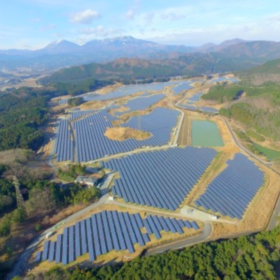
Pacifico Energy raises $265.6m with new PV investment fund, picks up 35 MW project in Japan
The Tokyo-based renewables developer has successfully launched its second solar investment fund, which will include roughly 216 MW (DC) of solar capacity across five sites in Japan.
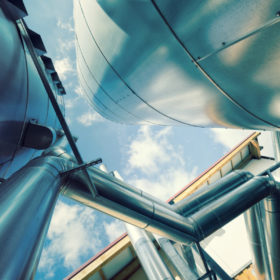
Construction begins at Hydrogen Park South Australia
The transformation of South Australia’s energy system has taken another step forward with early site works at a green hydrogen facility near Adelaide. The plant will integrate what is billed as Australia’s biggest electrolyzer of its kind.
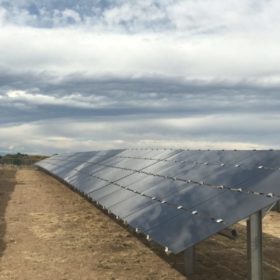
Colorado utility sees ‘opportunistic window’ with solar, wind, storage
Black Hills Energy is seeking 200 MW of solar power or wind plus energy storage capacity as part of a request for proposal, driven by summer 2019 bids for solar+storage of $0.024/kWh and $0.036/kWh and looming cuts to the 30% investment tax credit.

Ather Energy to set up Li-ion, EV production unit in India
Ather Energy, an Indian electric scooter maker, has signed a memorandum of understanding with the government of the Indian state of Tamil Nadu to open a new production facility for lithium-ion batteries and electric vehicles.

Germany registers 377 MW of new PV in October
Newly installed PV capacity hit 3.33 GW in the first 10 months of this year. Feed-in tariffs will drop in December by another 1% and the 52 GW subsidy cap looms, but for the first time, FITs for all project types are now below the €0.10/kWh mark.
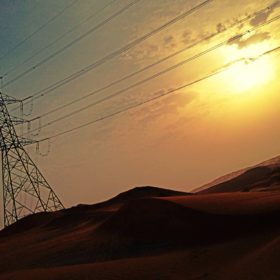
‘Green electrons and molecules’ from the desert
The new concept of the Desertec initiative, which was presented at the Energy Transition in the Arab World Conference in Berlin last week, is still based on the idea that large-scale solar and wind energy can be developed and used in the deserts of the Middle East and North Africa. It also includes, however, that hydrogen and other synthetic emission-free energy carriers can also be developed throughout the region with clean energy and then exported to world markets.
Narrowing down 166 billion battery materials
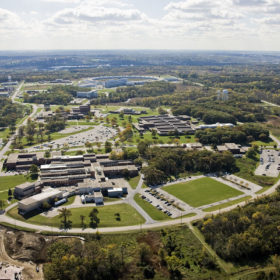
Researchers at the U.S. Argonne National Laboratory have applied a combination of machine learning and artificial intelligence to help narrow down a list of 166 billion molecules that could be used to form the basis of a battery electrolyte. The technique, say the researchers, offers a way to greatly reduce the cost of narrowing down such an enormous data set, while still providing a precise understanding of each molecule and its likely suitability.
Italy’s Eni wins Kazakhstan’s 50 MW solar auction with $0.032/kWh bid
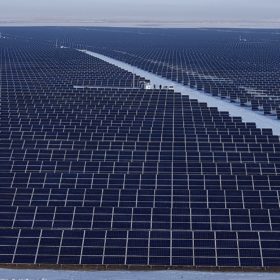
The 50 MW project is a joint initiative of the country’s Ministry of Energy and the United Nations Development Program.
Greece aims to install 5 GW of PV by 2030
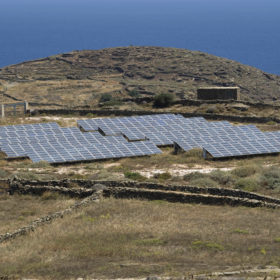
Greece has published a document that lays a path for national energy and climate policy over the next decade, while outlining plans to facilitate significant PV development through 2030.
New sandwich-like material for lead-free perovskite solar cells
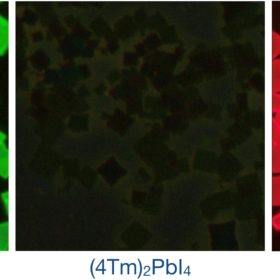
Scientists from Purdue University claim to have created a new material that incorporates both organic and inorganic materials. Its hybrid structure is said to improve the thermal stability of perovskite PV cells without the need to use lead.
