
Chinese PV Industry Brief: Polysilicon price exceeds $40/kg, another 5 GW of cell capacity comes online
Longi commissioned a 5 GW solar cell factory in Ningxia Province and Gokin Solar announced plans to build a 50 GW ingot factory in Sichuan Province. Furthermore, PV equipment manufacturer Jinchen supplied 2 GW of production lines to Adani Solar in India.
Alleviating battery storage growing pains through quality assurance
In this pv magazine Webinar, the quality assurance inspection body STS, will outline the key takeaways observed across more than 2 GW of inspected hardware, to provide an illustration of common areas of issue. The presentation will also include an overview of STS’ hierarchy of priorities, when it comes to assessing one’s own manufacturing processes for consistent quality.
Analyzing PV system safety and the promise of optimizers
There is no question that rooftop PV systems have to be safe, for residents, fire and emergency services, and for installers. However, how justified are some concerns being raised about system safety? And what missteps have been made while trying to mitigate some perceived threats? In this pv magazine Webinar, experts from SMA and Fraunhofer ISE will present real-world data on rooftop PV system safety and argue that some claims made about certain system architectures might not be as robust as claimed.
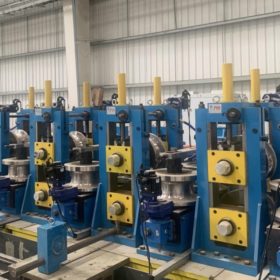
Arctech starts trial operations at 3 GW tracker factory in India
The Chinese company’s new manufacturing facility is equipped with fully automatic production lines and produces all major components for its solar tracker products.
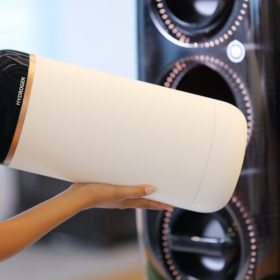
The Hydrogen Stream: Hydrogen cartridges for daily life applications from Toyota
Toyota starts testing hydrogen cartridges for use in mobility, household applications in Shizuoka Prefecture. Meanwhile, China’s Shaanxi Normal University designed an aerogel method to substitute platinum with ruthenium in electrocatalytic water splitting, the US Department of Energy (DOE) is getting closer to fund the Bipartisan Infrastructure Law’s $8 billion program, and UAE-based companies are stepping up cooperation with Azerbaijan, Japan and South Korea.

Maruti Suzuki switches on 20 MW solar carport in India
The carport can host about 9,000 vehicles and meet 11.5 % of the total electricity requirements of Maruti Suzuki’s factory in Haryana.
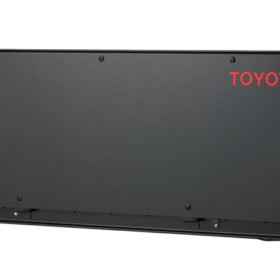
Toyota unveils 8.7 kWh battery for residential applications
The battery has a rated output of 5.5 kW and can be installed in outdoor environments. It is equipped with a hybrid power conditioner, a DC-to-DC converter, and a vehicle power supply adapter with a maximum output of 1.1 kWh.
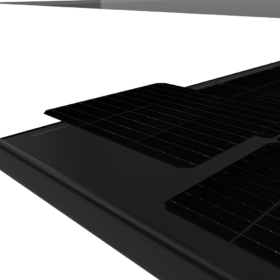
Solar module with frameless front side, improved drainage function
Chinese panel maker DAH Solar has developed a rooftop PV module with a new design that is claimed to enable water to wash away dust without the need for manual cleaning operations. The panel is offered in five versions with power output ranging from 450 W to 470 W and efficiency spanning from 20.85% and 21.78%.
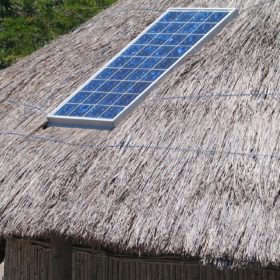
Irena gives latest update on stark chances of electricity access for all by 2030
The International Renewable Energy Agency’s latest annual report on the progress towards UN sustainable development goal seven estimates 670 million people will still lack electricity in 2030, and more than 2 billion will be reliant on unhealthy, polluting cooking methods.
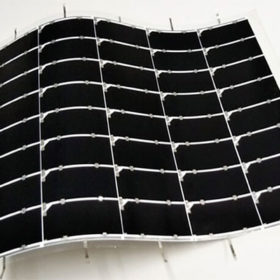
Sharp achieves conversion efficiency of 32.65% in flexible, lightweight solar module
The new prototype uses a triple-junction compound design, which sandwiches the solar cell between layers of film. The module is expected to be used in a variety of vehicles, an application that demands high efficiency and lightweight construction. Its conversion efficiency bests that of a similar Sharp module developed in 2016, which notched an efficiency of 31.17%, at the time a world record.
