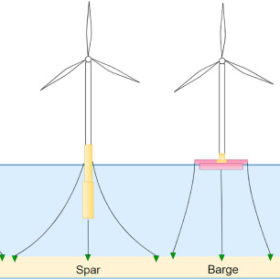
Renewable offshore floating hydrogen production
Scottish Development International and J-DeEP are developing a floating offshore hydrogen production plant off the coast of Scotland. Research shows the combination of large-scale offshore renewables and floating hydrogen production could soon become viable, depending on the project configuration.
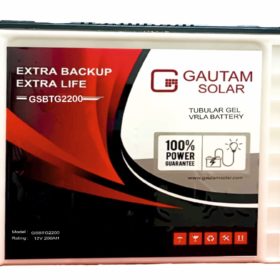
Gautam Solar releases gel battery solution for solar storage
India’s Gautam Solar says its gel batteries provide a safer, cost-effective, and long-lasting alternative for the energy storage space.
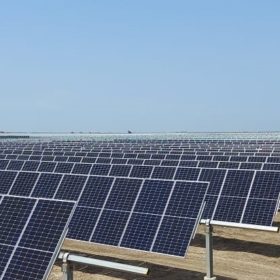
India’s utility-scale PV capacity hit 41.7GW in December
India installed 41.7GW of cumulative utility-scale solar capacity as of Dec. 31, 2021. It has another 44.6GW in the pipeline.
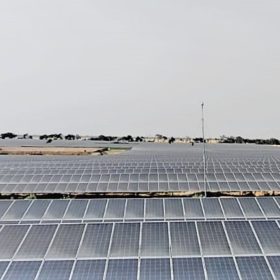
Tata Power commissions 160MW AC solar project for NTPC
Tata Power’s solar manufacturing and EPC unit has commissioned a 160MW AC solar project in the Indian state of Rajasthan.

Chinese PV Industry Brief: Zhonghuan raises wafer prices, China Resource Power procures 5GW of modules
Zhonghuan Semiconductor has ramped up wafer prices, China Resource Power has secured 5GW of solar panels, and GCL-Poly is preparing to rebrand as GCL Technology Holdings. China’s Guangxi Zhuang region, meanwhile, has announced plans to deploy 16GW of PV.

Carbon-based, HTL-free perovskite solar cells with 26% efficiency
An international research team has designed a carbon-based perovskite solar cell without a hole transport layer. Two plasmonic nanoparticles – Ag@SiO2 and SiO2@Ag@SiO2 – were added to the cell photoactive layer, in addition to a copper(I) thiocyanate (CuSCN) interlayer at the perovskite-carbon interface.
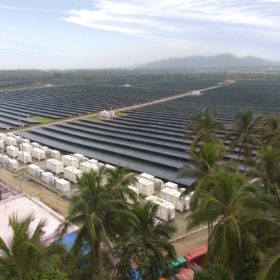
AC Energy, Citicore switch on 72MW solar park in Philippines
AC Energy, the renewable energy unit of Philippines-based conglomerate Ayala Corp., has finished building the 72MW Arayat-Mexico PV plant on the island of Luzon, in cooperation with Manila-based Citicore Power.
Tata Power commissions 300MW solar plant with single-axis trackers
Tata Power Renewables Energy Ltd. (TPREL), a unit of Tata Power, has commissioned a 300MW solar plant in the Indian state of Gujarat. It is purportedly the largest PV project with single-axis trackers in the country.

AC Energy to invest in PV in Bangladesh
AC Energy has revealed plans to invest in solar projects throughout Asia, including Bangladesh, by forming a joint venture with Germany’s ib vogt GmbH.

Solar tree designs for urban environments, carports
Scientists in India have designed a solar tree solution that can be used for both on-grid and off-grid applications, where space availability is a major constraint and the shading effect needs to be avoided. Four different system configurations have been proposed and all of them purportedly offer better land consumption ratios than conventional ground-mounted installations.
