
China’s emission-reduction action squeezes PV production
Industrial shutdowns and reduced factory production capacity levels indicate the companies producing the raw materials used by solar manufacturers are being afflicted by electricity consumption measures just as other sectors are. It is not clear whether the solar industry will be afforded any favors by Beijing, as analyst Frank Haugwitz explains.
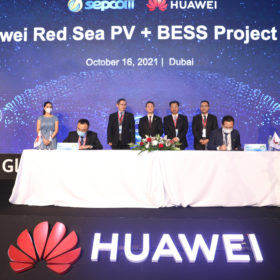
Huawei wins major energy storage project contract in Saudi Arabia
Chinese tech giant Huawei Digital Power has signed a contract with China’s SEPCOIII, a construction and engineering company and power plant operator, for a 400 MW PV plus 1300 MWh battery energy storage project in Saudi Arabia. Developed by ACWA Power, with SEPCOIII serving as general contractor and handling EPC services, the Red Sea Project […]
Solargiga reports nine-month figures
Shipments and revenue both rose in the first three quarters, for a company which this year announced the painful consequences of winding down its cell manufacturing operation were behind it.
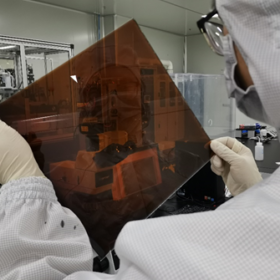
Chinese PV Industry Brief: Shuangliang signs billion-dollar wafer contract
This week, Shuangliang Eco-Energy has signed a multi-year sales contract for delivery of its PV wafers to solar cell manufacturer Jiangsu Runergy, and Wuxi-based perovskite start-up UtmoLight Technology has won a Pre-A round investment of RMB 220 million from several private equity funds.
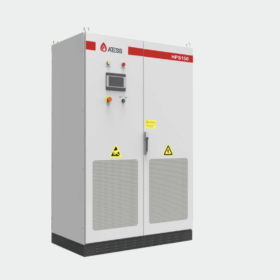
Atess Power launches new hybrid PV inverter for commercial applications
Chinese PV inverter manufacturer Atess Power has launched a new hybrid inverter for commercial solar power plants, featuring an efficiency of ≥96% and supporting up to 600kW system capacity.
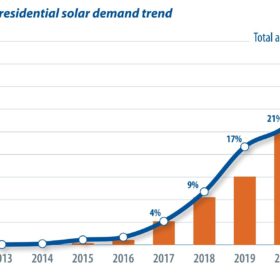
The evolution of residential PV in China
China is the largest residential PV market in the world, and this trend is only expected to strengthen in the next few years. By July 2021, China’s cumulative installed residential PV capacity had reached more than 30 GW, with a total of 1.864 million residential units hosting solar PV systems. IHS Markit’s Holly Hu looks behind these impressive numbers.
JinkoSolar sets new record for n-type solar cell efficiency
Manufacturing giant JinkoSolar has set another world record for n-type solar cell efficiencies with its TOPCon technology, this time pushing to 25.4%. The new world record was confirmed by JET laboratories in Japan, and surpasses JinkoSolar’s previous record of 25.25% set back in May.
China PV Industry Brief: 100 GW of solar for desert areas, new polysilicon production
China’s president has detailed plans to accelerate the planning and construction of large-scale wind and PV projects in desert areas, while Wuxi Shanghai announced new granular silicon and nano-silicon production capacity expansions.
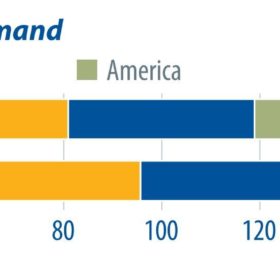
Solar supply, demand, and a foreign policy shakeup
As the solar market enters the busy season in September and October, module utilization rates are reaching 70% to 85%. However, structural shortages remain in the supply chain, with polysilicon supply running short in the face of high demand, writes PV InfoLink analyst Amy Fang. Prices, which were expected to stabilize, rose again in the second half. High module prices will cast a shadow on demand in the fourth quarter, prompting module manufacturers to postpone delivery for some orders from the second half into next year.
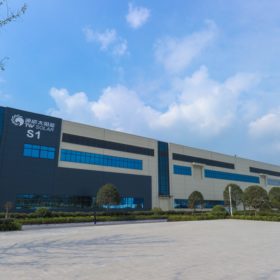
Chinese PV Industry Brief: New solar glass production lines and a new big wafer deal
Luoyang Glass is planning to deploy two solar glass production lines with an annual capacity of 1,200 tons each and wafer maker Wuxi Shangji has secured a big supply agreement from Longsheng New Energy. Furthermore, Tongwei has reported increasing profits driven by its polysilicon business.
