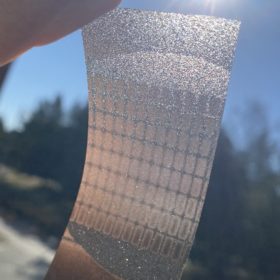
Monograin layer solar cell with 6.4% efficiency
The lightweight and flexible cell was built by Estonian researchers with microcrystalline powders. The device is claimed to be the most efficient solar cell fabricated with a semiconductor compound known as Cu2CdGe(SxSe1−x)4.
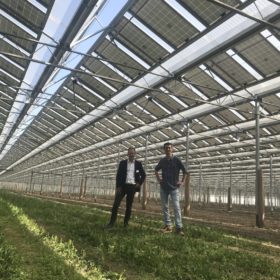
French photovoltaic greenhouse delivers 3.1 GWh and 4 tons/hectare of asparagus in one year
The solar greenhouse was built by French developer Tenergie in 2017 and last year recorded a remarkable performance in terms of both agricultural ane electricity yield.

Greece’s recovery plan to invest €10bn in clean energy
The Greek government has published its plan for a post-Covid economic recovery. The strategy aims to mobilize at least €10 billion towards the green energy sector, with the prospect of further EU loans on top.

Sweden hits 1 GW milestone
The Scandinavian country saw the installation of more than 400 MW of PV systems last year. The Swedish solar market keeps being driven by rooftop PV.

Germany added 350 MW of PV systems in February
The country saw the addition of PV systems totaling 880,8 MW in the first two months of the year. Its cumulative installed PV power grew to 54.3 GW.
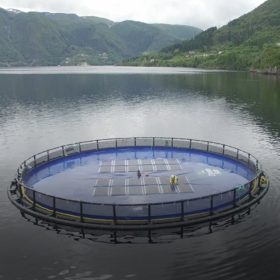
Norwegian floating PV specialist to provide tech for projects in Greece
Norway’s Ocean Sun has agreed to provide its technologies for utility-scale floating PV projects that Greek developer MP Quantum Group wants to build on lakes, reservoirs and sheltered coastal inlets. They expect to secure permits for the first demonstrator by the end of this year.

DNV publishes guidelines for proper deployment of floating PV
The Recommended Practice guide, on top of describing the most common requirements for building a floating PV array, provides a series of technical guidelines for electrical safety, anchoring and mooring issues, operation and maintenance, and specific plant design that can withstand site-specific environmental conditions.

Solar still largely underestimated
Two recent studies have separately shown that many scenarios assessing global decarbonization pathways are still predicting too-low future PV capacity and too-high LCOEs for the solar technology. The researchers analyzed scenarios provided by scientific researchers, government bodies and non-governmental organizations, including the United Nations’ Intergovernmental Panel on Climate Change (IPCC), the U.S. Energy Information Administration (EIA), the European Commission, the Indian government, the International Energy Agency (IEA), and the International Renewable Energy Agency (IRENA), among others.
Grid code compliance in megawatt projects – Practical commissioning in the Netherlands
Europe’s booming solar markets have seen new grid code compliance standards being introduced recently, and we will discuss what that exactly means for plant operators.
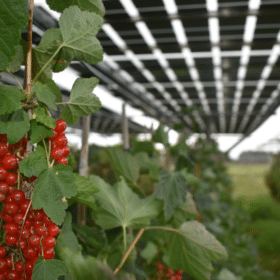
Baywa’s ‘fruitvoltaic’ project to bear fruit – 23 tons a year, in fact
A 1.2 MWp installation featuring more than 4,500 solar panels has sheltered a berry crop from high temperatures and damp to strengthen the claims made by agrivoltaics companies that their systems can offer climate change mitigation as well as clean energy.
