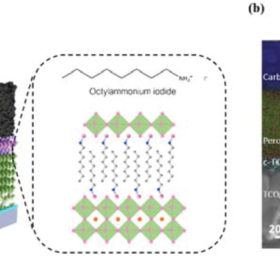
Electron blocking for 18.5%-efficient carbon-electrode perovskite solar cell
Scientists in Germany and Switzerland have developed a perovskite solar cell with a carbon electrode that achieved 18.5% efficiency. It also retained 82% of this after 500 hours of continuous illumination. While a long way behind what has been achieved with other perovskite solar devices, the cell is produced via all low-temperature processes that could likely be scaled into low-cost, large-scale manufacturing – making the approach one worth pursuing further.
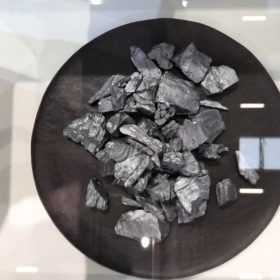
Wacker falls to fourth in global polysilicon ranking
The German company’s decision to cede market share to Chinese companies producing the material for solar panels, in order to focus on semiconductor-ready, electronic grade product, has seen it slip behind its rivals in terms of production scale.
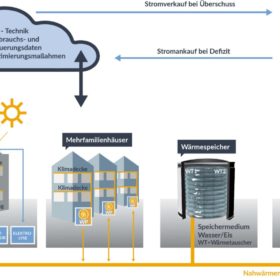
District heating via solar-powered heat pump using industrial waste heat
The Fraunhofer Institute for Solar Energy Systems is assessing how a solar-powered heat pump system that uses waste heat from a distillery at a low-temperature level could be used to provide district heating. Waste heat is injected into an ice storage tank, to which heat pumps are connected on the source side.
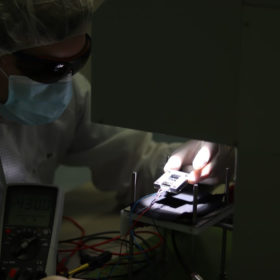
Ultra-thin perovskite-organic tandem solar cell with 24.0% efficiency
Researchers in Germany have built a perovskite-organic solar cell with low interfacial losses and a high open-circuit voltage. The device achieved an open-circuit voltage of 2.15 V, a short-circuit current of 14.0 mA cm−², and a fill factor of 80%.
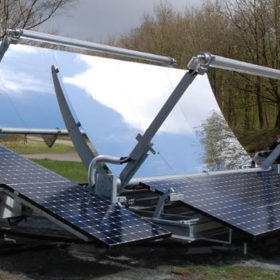
Concentrating solar power system for building applications, usable with PV
Conceived by a German start-up, the system is claimed to achieve a 75% efficiency in converting direct radiation into heat. It may be either equipped with solar trackers or photovoltaic modules, which would both occupy the same space on the front and lateral sides of the installations.
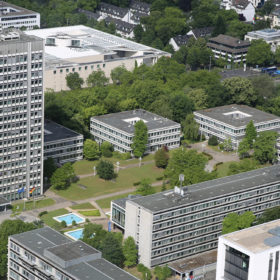
Germany allocates 1.08 GW of solar in PV tender
The tender concluded with a final average price of €0.0519/kWh, which is slightly higher than the €0.050 reached in the previous procurement exercise of the same kind. Bids ranged from €0.0405 to €0.055/kWh.
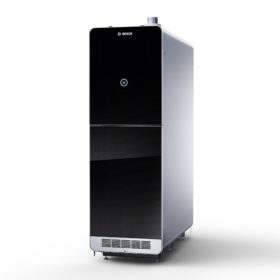
Bosch unveils hydrogen-compatible stationary fuel cell system
Bosch’s new solid oxide fuel cell prototype has an electrical efficiency of more than 60% and an overall efficiency above 85%. It also has a targeted power output of 10 kW and can produce up to 3 kW of thermal energy.
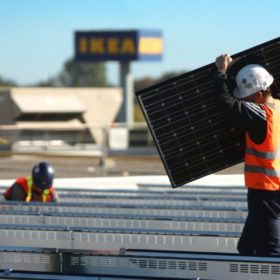
Ikea invests €340 million in solar
Ikea’s holding company, INGKA Holding, will invest €340 million ($371 million) to acquire nine PV systems from Enerparc. In the future, Ikea said it will work with Svea Solar to sell residential PV systems.
Germany introduces new provisions to support solar, wind
Germany has come up with new measures that could lead to a cumulative installed PV capacity of 215GW by 2030. Higher feed-in tariffs for rooftop PV will likely be announced soon.

SMA unveils new inverter for residential, commercial PV
SMA is offering a new line of four inverters with power ratings of 12kW, 15kW, 20kW and 25kW, for use in rooftop PV systems up to 135kW in size. It claims the inverters provide grid-compliant power control of entire systems and enable over-dimensioning of PV arrays by up to 150%.
