
Solarnative files for insolvency proceedings
The move follows failed efforts at Intersolar to find an investor or buyer. The manufacturer of micro inverters filed for insolvency right at the end of the trade fair.

Rooftop PV reduces building retrofitting costs by up to 50%
Cambridge researchers have analyzed the benefits of installing a PV system on the roof of an apartment building in addition to energy refurbishment and have found that photovoltaics, especially if combined with heat pumps, makes retrofit projects more affordable.

Home energy management systems: Compatibility, good forecasts and efficiency
The quality of home energy management systems is a concern for the industry. More than 300 participants at the pv magazine Focus Event in the conference center of the Munich Trade Fair Center made this clear. To provide a glimpse into the “black box,” manufacturers, scientists and users discussed the most important criteria.
Heat pump plus PV usually cheaper than gas heating after 11 to 14 years
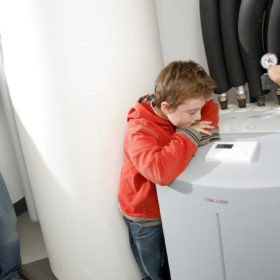
An analysis by Eon and Aachen University shows how quickly heat pumps with and without photovoltaic systems and storage pay for themselves in different types of homes, also in comparison to gas heating. A heat pump with photovoltaics is usually more economical than without. Balcony solar usually pays for itself in three to six years. An accompanying survey shows that most people underestimate the economic viability of climate-friendly energy technologies.
Fraunhofer IAO, DHBW Heilbronn examine decentralized hydrogen storage
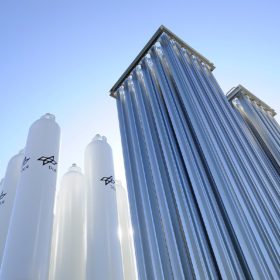
Researchers have analyzed various storage options for green hydrogen, such as in neighborhoods, at company locations and on campus grounds. Their study provides an overview of the respective advantages and disadvantages of physical, chemical and pure hydrogen storage.
Trades against the machine
Large battery storage systems are taking on an increasing number of tasks in the German grid, meaning that the volume and speed of transactions can no longer be managed without computers. As a result, traders are working on algorithms to fully automate transactions.

Intersolar: AP Systems presents single-phase hybrid inverter for balcony photovoltaics
Until now, balcony inverters were mostly simple micro inverters, with batteries integrated via MC4 connectors. A hybrid inverter should improve this situation.

The Hydrogen Stream: Russian researchers propose hydrogen extraction from gas wells
While a team of Russian researchers proposed a novel approach to produce hydrogen directly in gas wells, Plug Power and CPH2 secure certification for the hydrogen systems.

Wavelabs unveils solar simulator for perovskite mini-modules
Wavelabs, a German testing equipment manufacturer. unveiled a new solar simulator suitable for perovskite and thin film mini-modules.
Noise-barrier integrated photovoltaics for highways, railways
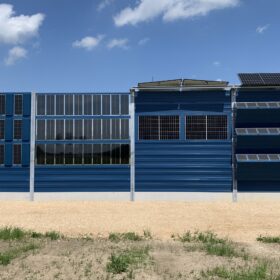
A German research team is field testing new module concepts that can be integrated into noise barrier walls alongside roadways or railways. The hope is that some of the designs will emerge as cost-effective, power-generating solutions for application in newly constructed soundwalls, in retrofits, or in add-on projects.
