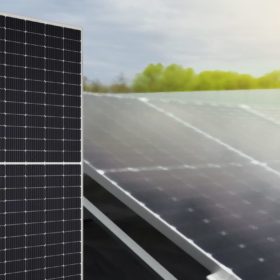
Sharp develops 445 W half-cut panels for large scale PV
The new panel is manufactured with M6 wafers. It features a power conversion efficiency of 20.1% and a temperature coefficient of -0.347% per degree Celsius.
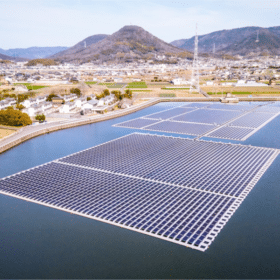
Sumitomo Mitsui Construction deploys in-house floating PV tech
Sumitomo Mitsui Construction has used its PuKaTTo proprietary tech for a 2 MW floating PV project in Japan’s Kagawa prefecture. It said its durable, easily deployable floats can host 60-cell and 72-cell solar modules.

Solid-state batteries in space
Japanese scientists are about to launch solid-state batteries into space.
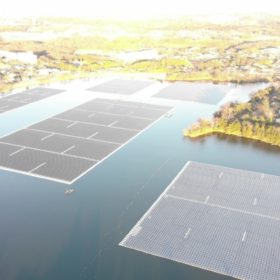
Japan’s largest floating PV plant being reconstructed after Typhoon impact
French floating PV specialist Ciel&Terre said the plant is being split into smaller islands, with a square shape, to avoid stress concentration.
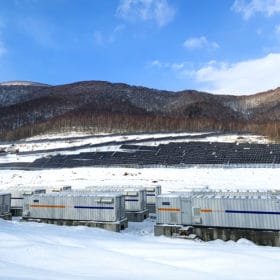
Solar-plus-storage as an antidote to grid congestion in Japan’s northern island of Hokkaido
Chinese inverter maker Sungrow has switched on a 6 MW / 21 MWh solar-plus-storage facility on the island. The FIT project’s connected AC capacity is limited to only 845 kW, but the containerized storage solution provided by the company ensures its viability.

Panasonic to exit solar manufacturing
The Japanese brand will continue to sell third-party-made modules under its brand in its home market, as it already does overseas, but in-house PV wafer, cell and module production will halt by the end of fiscal year 2022.
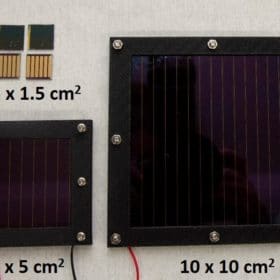
Mini perovskite solar module with 14.55% efficiency
The 5x5cm device was developed by a Japanese research group. The thickness of the perovskite films was increased to reduce defects and pinholes and this was achieved by adding ammonium chloride to the lead iodine solution used in the formation of the films. The device was able to work for 1,600 hours at more than 80% of this efficiency.

The world won’t wait – Biden needs to catch up
The inauguration of Joe Biden as the 46th President of the United States has brought hope the country will play a central role in the world’s energy transition and combating climate change. However, rather than teaching other countries lessons, the U.S. will need to catch up with the rest of the world, and it needs to do so quickly – the world won’t wait for the U.S.
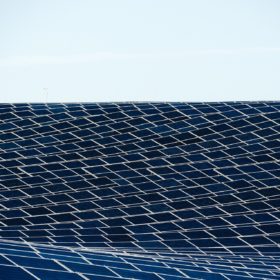
Jenny Chase predicts up to 194 GW of solar this year
Falling module prices will help PV post another record year after an estimated 132 GW was installed worldwide in 2020, according to an energy transition investment trends report published by Bloomberg New Energy Finance.

Mitsubishi and Japanese university offer peer-to-peer trading alternative to FIT payments
Blockchain systems are being tested as a means of offering solar households revenue for excess power they generate, now the FIT program has ceased.
