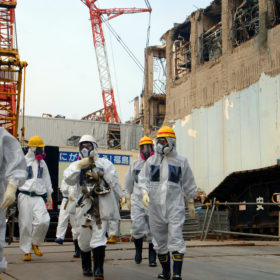
New Japanese environment minister touts end of nuclear power
After Fukushima, Japan’s nuclear power fleet went offline with plans to restart only when safety concerns could be addressed. On his first day at the office, the new environment minister has said he has no intention of ever restarting the reactors. The move could put Shinjiro Koizumi at loggerheads with PM Shinzo Abe, a vocal proponent of nuclear.
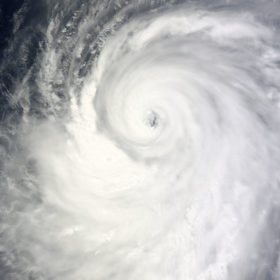
Japan’s largest floating PV plant catches fire after Typhoon Faxai impact
Kyocera’s 13.7 MW floating project at the Yamakura Dam was damaged by 120mph winds the typhoon brought to the coastal city of Chiba. Firefighters said the blaze may have been generated by the strong heat produced by panels stacking up.

Softbank injects another $10m into Swedish dye-sensitized solar specialist Exeger
The Japanese multinational lender is making its second investment in the Swedish start-up. The funds will help the company ship its first products next year.

Japan’s fourth solar auction concludes with lowest bid of $0.098/kWh
The tender produced lower bids than previous rounds but again allocated less generation capacity than planned. The Japanese government initially accepted bids for a combined 589.9 MW but ended up assigning only 195.8 MW of capacity. The final average price for procured solar power was $0.1222/kWh.
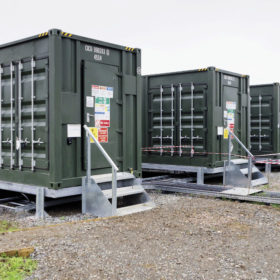
Kenyan government blamed for sluggish progress of solar
Two solar farms with 80 MW of generation capacity tendered in 2017 are being built and will be commissioned this year but another two, allocated at the same time, are no nearer construction. Kenya, however, has been touted as the site of Africa’s first wind-solar-storage hybrid project.
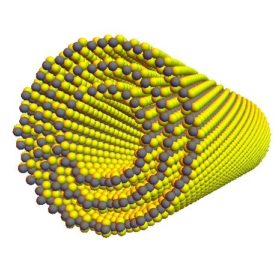
Scientists discover photovoltaic nanotubes
An international team of researchers led by the University of Tokyo has discovered a new material which, when rolled into a nanotube, generates an electric current if exposed to light. If magnified and scaled up, say the scientists, the technology could be used in future high-efficiency solar devices.
Another 300 MW solar auction for Japan
The procurement exercise, which closes tomorrow, will be open to projects larger than 500 kW in size. The results will be announced on September 3.
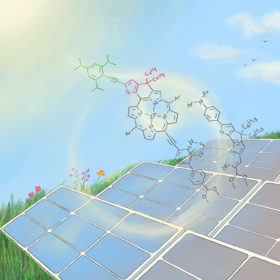
Japanese scientists develop dye-sensitized cell with 10.7% efficiency
The improved performance was achieved by using a methylene bridged material, the molecular dye DfZnP-iPr.
Asian battery manufacturers eye European riches on offer
A report produced by an AI and automation market research company says an anticipated boom in the European storage market – driven by a desire to reduce carbon emissions – will attract producers as demand outside China tails away.
Tepco reveals plan to spin off global renewables unit
The Japanese utility will set up a new, separate company early next year to oversee its renewables generation business, but says it remains committed to developing 6-7 GW of new projects in the years ahead.
