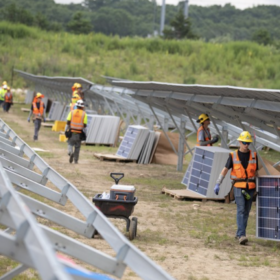
US solar faces 53,000-worker gap ahead of 2026 deadline
The US solar industry may fall short of workforce needs as developers race to meet July 4, 2026 construction deadlines tied to federal tax credits.

US adds 26.6 GW of solar in 2025 as renewables dominate
Solar and wind accounted for nearly 90% of all new utility-scale generating capacity added to the US grid through December 2025, according to the Federal Energy Regulatory Commission (FERC).
Tracker-based agrivoltaics turn fields into wind-safe zones
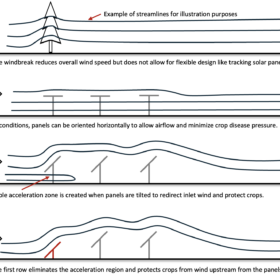
Cornell University researchers demonstrated that tracking solar panels in agrivoltaic systems can protect crops from wind damage while allowing airflow, outperforming traditional single-row tree windbreaks. They also proposed a new lowered-first-row panel design that improves wind protection, achieving up to 86% reduction in shelter-zone wind speeds under extreme conditions.
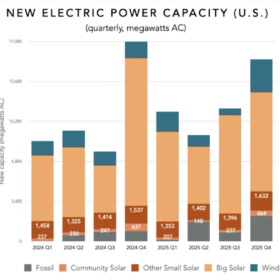
US small-scale solar hits record 1.9 GW in Q4 2025
Distributed solar accounted for 15% of all new US power capacity in 2025, as residential and community projects reached record installation levels.

U.S. national laboratories lead multi-agency push for solar cybersecurity standards
The U.S. Department of Energy is deploying a research framework across four national laboratories to harden the domestic power grid against digital vulnerabilities as solar deployment accelerates.

US startup begins manufacturing grid-scale flywheel ESS
SOSV-backed Qnetic is aiming to raise $20 million in 2026. Over the next two years it will work with the National Lab of the Rockies and other partners on field testing and validating its technology across multiple use cases.
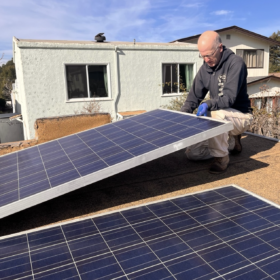
DIY plug-in solar shows $0.65/W potential in US market
Achieving a system cost of $0.65/W through the secondary market and do-it-yourself assembly demonstrates a viable pathway for US plug-in solar to provide immediate utility bill relief to renters and apartment dwellers.
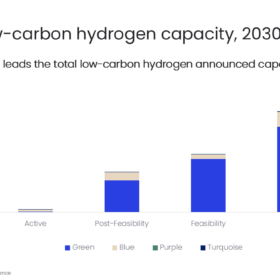
The Hydrogen Stream: Capacity outlook grows, deals shift
GlobalData says hydrogen capacity could reach 82.3 million metric tons per annum (mtpa) by 2030, while Topsoe has ended supply agreements with First Ammonia.

US ITC opens Section 337 probe into global TOPCon supply chain
The US International Trade Commission (ITC) has opened a Section 337 investigation into tunnel oxide passivated contact (TOPCon) solar cells, modules, panels, and related products following a complaint by First Solar, naming 47 entities across 11 countries as respondents.
California bill targets DER access to resource adequacy market
California Senator Josh Becker says proposed legislation would require regulators to allow distributed energy resources (DERs), including batteries and electric vehicles, to participate in the state’s grid reliability market.
