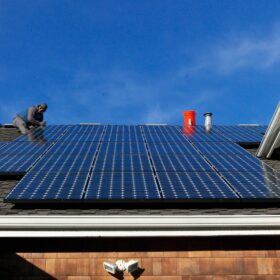
Novel tool for PV system sizing allows users to assess tradeoffs between reliability and costs
Developed by scientists in Egypt, trhe Green Energy Solutions software allows users to assess the tradeoffs between the PV system reliability and its costs. Compared to PVsyst, it has an error margin of up to 9%.
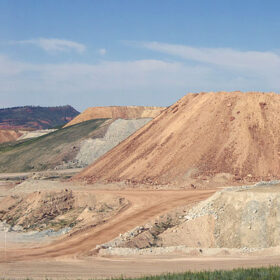
World’s largest phosphate-based fertilizer maker shifts to solar
Morocco-based rock miner OCP secured financing to build two solar PV plants totaling 400 MW from the International Finance Corporation, with the twin facilities located near the mining towns of Benguerir and Khouribga – home of the country’s most phosphate-rich reserves.
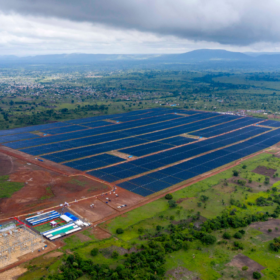
AMEA Power reaches financial close on 120 MW of solar in Tunisia
Dubai-based AMEA Power has signed concession and power purchase agreements (PPA) with the Tunisian government for its 120 MW solar project in Metbassta, northern Tunisia.

Powering bio-based earth homes with photovoltaics
Moroccan researchers have investigated the potential energy savings of PV systems integrated with biomaterial-based walls in rural areas. They say that solar-powered earth homes could achieve a levelized cost of electricity (LCOE) of $0.218/kWh.
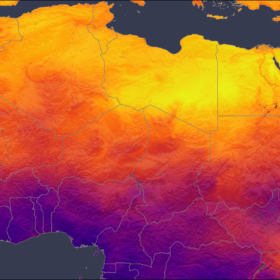
Seasonal solar patterns present opportunity in North Africa
In a new weekly update for pv magazine, Solcast, a DNV company, explains that the climatology of Africa leads to very different seasonal generation patterns from what European solar producers experience. Data analysed by Solcast, via the Solcast API, shows this seasonal variance from summer to winter in 2023.

Infrastructure reform is key to accelerating Africa’s energy transition
In its latestt monthly column for pv magazine, the International Renewable Energy Agency explains that, in order to realize Africa’s vast potential, we must ensure there is adequate investment and infrastructure development to support renewable energy. In the coming years, this means urgently overcoming the structural barriers across three priorities: infrastructure, policy, and institutional capabilities.

New bio-inspired based algorithm to improve PV output under partial shading
The novel algorithm is based on the behavior of marine animal tunicates and reportedly provides remarkable results in terms of power errors. It was tested in four PV system configurations with five different shade patterns.
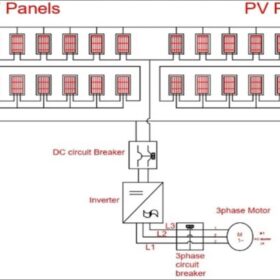
Underground photovoltaic water pumping system with average system efficiency of up to 8.5%
Developed by Egyptian scientists, the PV-powered water pumping system may produce up to 181.8 m3 of water per day. The system consists of two PV arrays with each a capacity of 4.6 kW and a pumping unit made up of a 7.5 kW three-phase alternating current motor, a multistage submersible pump, a deep well, and a 15 kW inverter.
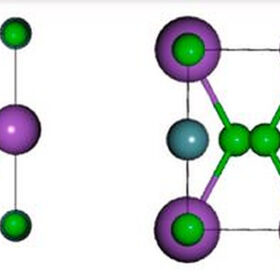
New perovskite material for lead-free solar cells
An Algerian research group has analyzed the electronic, elastic, optical, and thermoelectric characteristics of the KGeCl3 perovskite to verify if this lead-free material may be used for solar cells and other electronic devices. The scientists found that the novel material has a direct bandgap semiconductor with bandgap energies of 0.92 eV, 1.26 eV, and 1.88 eV for cubic, tetragonal, and orthorhombic phases, respectively.
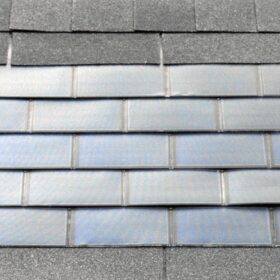
IEA-PVPS releases guide for applying innovation system approach to BIPV
IEA-PVPS has published a new handbook that provides support for Technological Innovation System (TIS) analysis for building-integrated photovoltaics (BIPV).
