
Türkiye publishes rules for floating solar
Türkiye has published a regulatory framework covering the legal basis for developing floating solar plants on reservoirs and dams. The rules establish where floating solar can and cannot be built and how projects can be approved.

Turkey attracts 77 applications in 650 MW solar tender
Turkey’s latest renewable energy tender received 77 applications from 38 different companies across eight available solar projects, including the country’s first floating PV plant. Winners will be announced before the end of the year.

Alfa Solar and Astronergy plan solar cell, wafer venture in Turkey
Astronergy Europe says its new venture with Alfa Solar will build an integrated cell and wafer plant with 2.5 GW of initial capacity in Turkey.
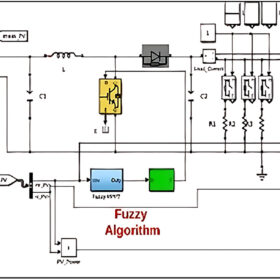
Optimizing PV system tilt angle, MPPT using fuzzy logic controller
Researchers in the Middle East have developed a fuzzy logic controller that simultaneously optimizes the tilt angle of PV systems and performs maximum power point tracking (MPPT). Year-long simulations indicate that the proposed approach increases power generation by approximately 20%.
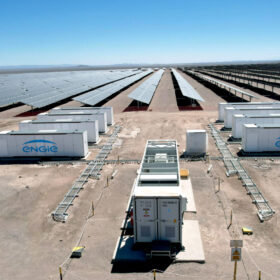
Hybrid PPA model improves PV-BESS bankability, say researchers
Researchers have modeled a hybrid financing scheme combining contracted and merchant components to improve the bankability of PV-battery energy storage system (PV-BESS) assets, using a Bayesian LSTM forecast integrated with a MILP optimization model to assess performance.

KAUST achieves 28.7% efficiency in perovskite-perovskite-silicon tandem solar cell
An international team of researchers led by King Abdullah University of Science and Technology has fabricated a triple junction perovskite-perovskite-silicon tandem solar cell that achieved a world record efficiency for this cell architecture. The device incorporates stabilized perovskites that ensure improved performance and stability.
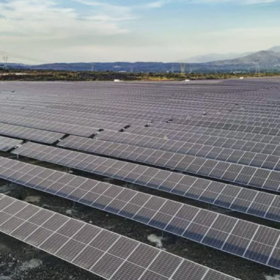
Banks fund $65 million for 100 MW solar project in Turkey
The Asian Infrastructure Investment Bank (AIIB) and Industrial Development Bank of Turkey (TSKB) have each contributed $32.5 million toward a senior debt financing package for a 100 MW solar project in southern Turkey.

Türkiye to tender 850 MW of solar
Turkiye’s next renewable energy tenders plan to allocate 850 MW of solar alongside 1,150 MW of wind across November and December. A ceiling price of €0.055 ($0.065)/kWh has been set, alongside floor prices of €0.0325/kWh for the solar tenders and €0.0350 for the wind tenders.

Türkiye deploys 3.1 GW of solar in H1
Türkiye’s cumulative solar capacity surpassed 23 GW in June, according to figures from energy thinktank Ember, exceeding the country’s target for 2025. However, a lack of connection capacity for future projects is threatening to slow deployment rates in the short to medium term.
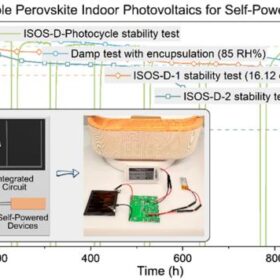
Scientists build 42.01%-efficient indoor PV cell for self-powered devices
An international researc team has included an interlocked self-assembled monolayer in perovskite indoor PV to enhance its stability and durability. Fabricating cells, mini modules, and a prototype device of an electronic price tag, the novel structure was tested. It was found to exhibit a lifetime approaching 6,000 hours.
