
Hanergy-owned Alta Devices reportedly lays off 250 employees without notice
The U.S. business built and sold record-setting gallium-arsenide solar cells but its parent has seemingly run out of patience. Having failed to give its workers notice of the move, Hanergy is either in contravention of U.S. employment law, ‘faltering’ or subject to ‘unforeseen business circumstances’.

pv magazine announces veteran industry journalist, Eric Wesoff, as US senior editor
pv magazine group welcomes Eric Wesoff as the new editorial leader of the U.S. platform. With two decades of experience working in the renewable energy industry, Wesoff brings a plethora of expertise in solar power, advanced batteries, clean technology investing and finance, utility structures, and the electric grid.
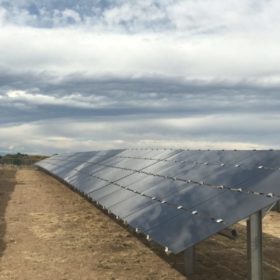
Colorado utility sees ‘opportunistic window’ with solar, wind, storage
Black Hills Energy is seeking 200 MW of solar power or wind plus energy storage capacity as part of a request for proposal, driven by summer 2019 bids for solar+storage of $0.024/kWh and $0.036/kWh and looming cuts to the 30% investment tax credit.

Narrowing down 166 billion battery materials
Researchers at the U.S. Argonne National Laboratory have applied a combination of machine learning and artificial intelligence to help narrow down a list of 166 billion molecules that could be used to form the basis of a battery electrolyte. The technique, say the researchers, offers a way to greatly reduce the cost of narrowing down such an enormous data set, while still providing a precise understanding of each molecule and its likely suitability.
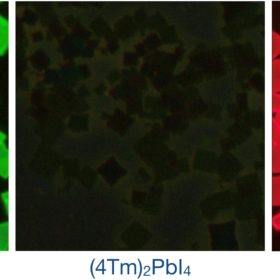
New sandwich-like material for lead-free perovskite solar cells
Scientists from Purdue University claim to have created a new material that incorporates both organic and inorganic materials. Its hybrid structure is said to improve the thermal stability of perovskite PV cells without the need to use lead.
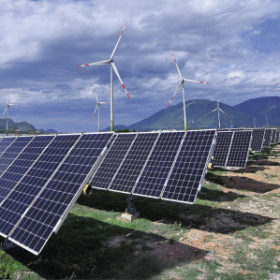
Hybrid power plants, and the move beyond LCOE
A new paper published by the U.S. National Renewable Energy Laboratory delves into the potential of hybrid power plants combining wind and solar generation. Development of such plants, according to the lab, is driven by the need to increase profitability and consider metrics beyond levelized cost of electricity, taking into account time varying revenues and better managing these renewables inherent variability.

MIT scientists develop a coating for perovskites
Researchers at the Massachusetts Institute of Technology have developed a transparent coating they successfully incorporated into a perovskite solar cell, increasing efficiency and stability. The group says with further improvements the material could be used as a simpler, less expensive alternative to widely used indium tin oxide as a transparent conductive material for a range of applications.

Clean energy must be rolled out six times faster
To have any hope of restricting global heating to a maximum of 1.5 degrees Celsius, the renewables success story which saw 108 GW of solar deployed last year needs to be cranked up to the next level – and fast.

Renesola exits Vietnam, India and Korea
The Shanghai-based project developer – which will soon relocate to the U.S. – says the profit margins are not high enough in those markets and has cancelled its project pipeline in the nations. The company has also changed its CEO after less than five months and is on a drive to reduce capital costs.
Peering into a 55% solar future for the US
National Renewable Energy Lab researchers conducted hourly modelling based on a future energy mix containing 55% solar power and found spring days of free electricity among the results, emphasizing the critical role energy storage will play.
