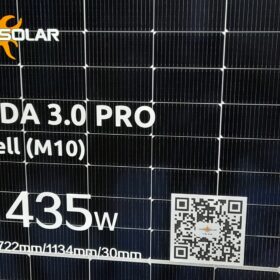
Yingli releases 435 W n-type TOPCon solar panel with 22.28% efficiency
Yingli is offering six versions of its 108-cell Panda 3.0 PRO modules, with power outputs ranging from 410 W to 435 W and efficiencies ranging from 21.0% to 22.28%.
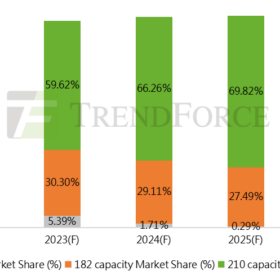
Top PV module manufacturers by shipment volume in 2022
TrendForce has ranked the top six module manufacturers by shipment volume in 2022, with Longi topping the list, followed by Trina Solar and JinkoSolar. JA Solar, Canadian Solar, and Risen Energy rounded out the top six, in a year dominated by large-format modules.

How many solar panels would have been needed to power the Death Star?
How many 400 W panels would The Empire have needed to keep the lights on in the Death Star, had Emperor Palpatine had an ESG audit to sign off? How many PV modules would Marty and Doc have needed to fix on the DeLorean to get the flux capacitor fired up? pv magazine and English solar installer Solar Fast are happy to provide the answers…
Canadian Solar to significantly increase supply chain capacity
CSI Solar, a Canadian Solar subsidiary, is increasing its manufacturing capacity in 2024 by adding significantly more ingots, wafers, cells and modules, in order to meet strong market demand and accelerate growth.
Trina Tracker unveils 2P tracker solution with new features
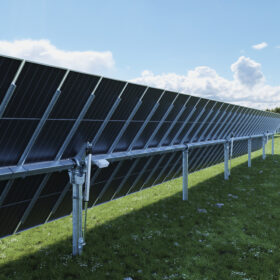
Trina Solar’s tracker subsidiary has launched a new version of its Vanguard single-axis two-in-portrait (2P) tracker. It uses multiple motors on one tracker row, reportedly allowing it to withstand higher wind loads and reduce tilt angle misalignment. The new solution is compatible with large modules up to 685 W.
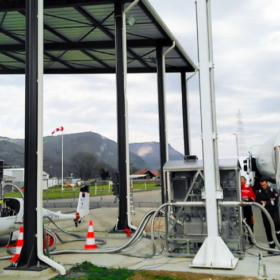
The Hydrogen Stream: Hydrogen-electric powertrain for aircraft
H2FLY has wrapped up initial filling tests with the liquid hydrogen tank for its HY4 aircraft, while Wingcopter has announced the development of a hydrogen-fed delivery drone.
TOPCon for homes
In this pv magazine Webinar, we will learn about the premium technical features of TOPCon technology highlighting the impact on the LCOE of residential projects. We’ll also examine TOPCon’s rapid route to large-scale production and expected growth over the coming years.
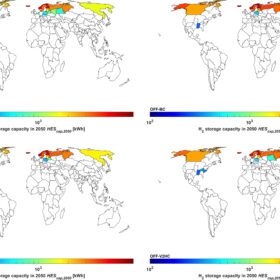
Seasonal hydrogen storage for residential self-consumption
Finnish and German researchers have assessed the role of seasonal hydrogen storage for PV prosumer households with a “least-cost” model at a global level up to 2050. They have found that seasonal hydrogen storage can only be expected in a niche, off-grid market.
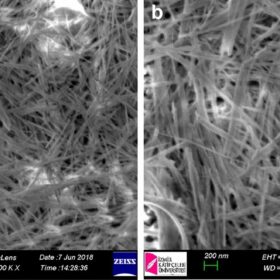
‘Natural clay’ additive promises gains in perovskite solar cell efficiency, stability
Scientists in Turkey have demonstrated that sepiolite, a naturally occurring clay substance, can be added to perovskite precursor materials, and form a scaffold layer that can improve the efficiency and stability of the cells. The scientists believe that this substance could be valuable in developing reproducible processes for the production of large-area perovskite solar cells.
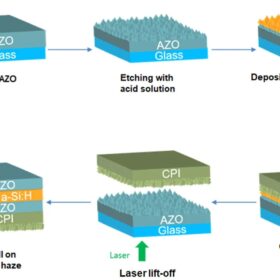
Hydrogenated amorphous silicon solar cell for BIPV, bifacial applications
Scientists in South Korea have developed a flexible, transparent solar cell with an average visible transmittance (AVT) of 88.3%. They have also created an n-type rear window layer to optimize bifacial operation.
