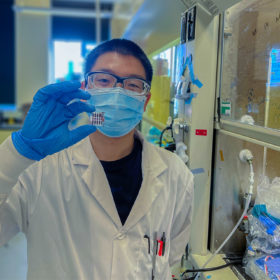
Quantum adjustments for 23.9%-efficient inverted perovskite solar cell
Scientists in Canada fabricated a perovskite solar cell based on an inverted structure that achieved 23.9% efficiency, and maintained 92% of its initial performance after 500 hours of accelerated aging tests. By carefully controlling the thickness of the perovskite layer, the group was also able to gain control of “quantum mechanics” properties such as the movement of electrons within the layer and the wavelengths of light absorbed.
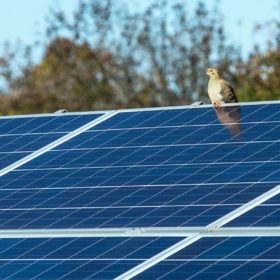
Solar power on pace to save the world
A think tank analysis suggests that if solar power keeps up its growth pace, along with wind, then the global power sector will meet its carbon reduction targets to keep world temperatures in check.

New report calls for collective action to address forced labor risks in the PV value-chain
As the world woke up to the news of war in Ukraine, the German Bundestag called a special session at which the finance minister, Christian Lindner, announced a package of measures in response to the crisis. A key plank, he said, would be a new focus on renewables.
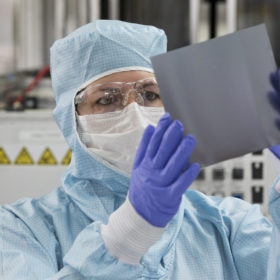
New technologies, new opportunities
UK-based analyst Exawatt and Germany’s Nexwafe published a white paper this week that takes a close look at the current state of PV manufacturing worldwide, and how Nexwafe’s innovative wafer production tech might fit into it. They said that if the potential of its Epiwafer can be realized, the PV industry may yet see “another revolution in wafer manufacturing.”
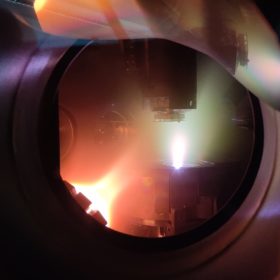
The Hydrogen Stream: New tech for solar water splitting
Helmholtz-Zentrum Berlin has unveiled new technology to improve thin metal oxide films for solar water splitting, and the European Energy Exchange has announced plans for a new hydrogen index. Indian Oil, Larsen & Toubro, and ReNew have agreed to set up a joint venture to develop India’s green hydrogen sector. And Iberdrola has revealed a plan to produce industrial green hydrogen, in cooperation with the European Investment Bank.

Solar the energy workhorse in latest gloomy IPCC verdict
Photovoltaics can wipe out 4.25 billion tons of carbon emissions every year this decade, according to the UN Intergovernmental Panel on Climate Change. Even so, the actions announced so far remain way short of what is needed, with capital flows to fossil fuels still greater than the cash directed toward combating climate change.

Berlin Energy Transition Dialogue – global challenges and the role of renewables
The second day of the Berlin Energy Transition Dialogue was dominated by the role of renewables in facing three world crises: climate change, the Covid-19 pandemic, and the war in Ukraine.

The mobility rEVolution: Second-life battery applications with ‘pick-n-mix’ cells connected in series
In other news, the UK charging infrastructure is in for a major boost, Volkswagen aims to catch up with Tesla, and the first all-electric Rolls-Royce completes winter tests near the Arctic Circle.
Stimulus for green hydrogen demand crucial for the energy transition
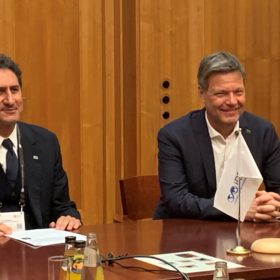
The Berlin Energy Transition Dialogue 2022 event has shown the centrality of renewables and green hydrogen in the world’s future energy landscape. pv magazine spoke with the General Director of the International Renewable Energy Agency, Francesco La Camera, about the difficulties of creating a hydrogen economy in the absence of demand. According to him, public support and policies will be crucial to overcoming this challenge.
Rooftop & TOPCon: Appraising the benefits of TOPCon PV modules on LCOE for distributed generation project
In this pv magazine Webinar, we will learn about the premium technical features of TOPCon technology highlighting the impact on the LCOE of distributed generation (DG) projects, including calculation of the yield benefit for different environmental conditions and installation types to support project developers, EPC contractors, stakeholders for practical component selection decisions. Different business cases will be introduced and discussed to ascertain how TOPCon technologies may also be considered for improving a DG project’s quality and viability.
