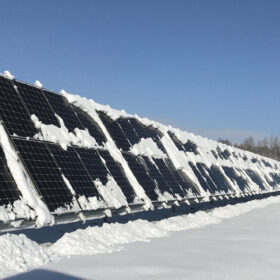
Weekend Read: Data harvesting
Mounting system manufacturers back their technology but farmers still have questions about the realities of solar on agricultural land. Ramping up research on how agrivoltaics affect farming yields could provide vital answers.
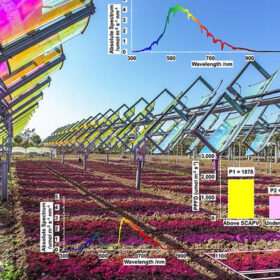
New system design for spectral-splitting concentrator agrivoltaics
Researchers in China have build a 10 kW spectral-splitting concentrator agrivoltaic system that accomodates small farming equipment below it. The installation relies on 128 concentrator modules integrating each an ultra-white and toughened concentrating curved glass (CCG), a multilayer polymer film (MPF) and 23%-efficient interdigitated-back contact (IBC) crystalline silicon solar cells provided by Sunpower.
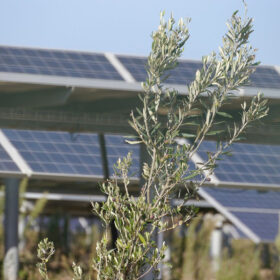
Weekend Read: Barren soil for agrivoltaics
PV has real potential on agricultural land in Italy, where multinationals and entrepreneurs alike share an enthusiasm for solar innovation. This is being hindered by a piecemeal approach to regulation.
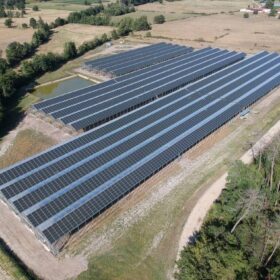
Italian agrivoltaics could be a vital plank of the EU’s energy transition
Europe awakened to its energy dependency on Russian gas as the Russia-Ukraine conflict unfolded and the war has pushed the European Union to accelerate its energy transition. Italy could play an important role.
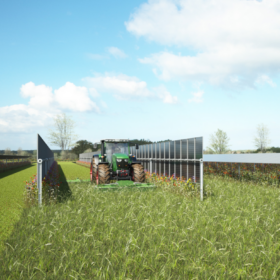
Luxembourg allocates 52.7 MW in agrivoltaic tender
The Luxembourg Ministry of Energy has allocated 52.7 MW in an agrivoltaics tender. While the final prices from the procurement exercise have not been disclosed, the ministry said it considered ecological and agricultural factors.

Agrivoltaic system design for olive cultivation
A research team in Spain has developed a PV system layout for super-intensive olive groves. The scientists said the system must ensure high levels of transparency in order to avoid a negative impact on the olive yield.
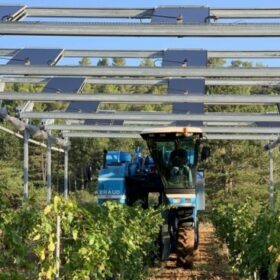
TotalEnergies acquires French agrivoltaics specialist Ombrea
TotalEnergies has become the sole shareholder of French agrivoltaics specialist Ombrea, in a transaction that builds upon the partnership they started in 2019.
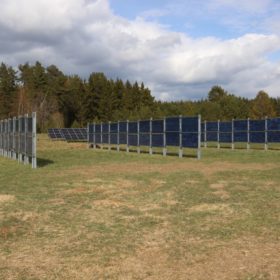
Vertical agrivoltaics to reduce PV curtailment, increase water efficiency
An international research group has analyzed a vertical bifacial agrivoltaics system in a drought-stricken part of Chile. They say that the solar array can improve water efficiency for crop irrigation, while the vertical system configuration optimizes PV power generation throughout the day, minimizing curtailment.
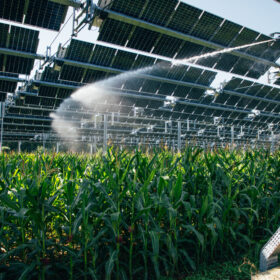
French developer builds agrivoltaics facility with irrigation system
TSE has installed a 2.9 MW agrivoltaics plant in northern France with sensors to trigger an irrigation system. The irrigation setup can reportedly achieve significant water savings. The company is selling the electricity under a 20-year power purchase agreement (PPA).

Agrivoltaic facilities with single-axis trackers have lower LCOE than those with fixed structures
New research from Belgium shows agrivoltaic facilities with trackers perform significantly better than projects with fixed structures. The scientists found projects with tracking achieved an LCOE of €0.077 ($0.082)/kWh, while facilities with fixed structures were found to have an LCOE of €0.10/kWh.
