Vertical agrivoltaics to reduce PV curtailment, increase water efficiency
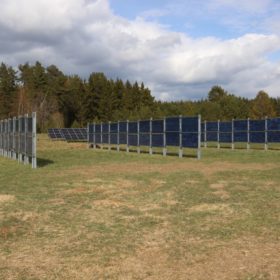
An international research group has analyzed a vertical bifacial agrivoltaics system in a drought-stricken part of Chile. They say that the solar array can improve water efficiency for crop irrigation, while the vertical system configuration optimizes PV power generation throughout the day, minimizing curtailment.
French developer builds agrivoltaics facility with irrigation system
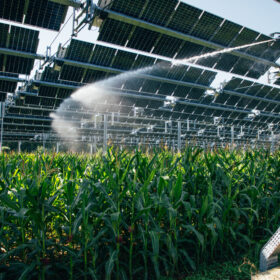
TSE has installed a 2.9 MW agrivoltaics plant in northern France with sensors to trigger an irrigation system. The irrigation setup can reportedly achieve significant water savings. The company is selling the electricity under a 20-year power purchase agreement (PPA).

Agrivoltaic facilities with single-axis trackers have lower LCOE than those with fixed structures
New research from Belgium shows agrivoltaic facilities with trackers perform significantly better than projects with fixed structures. The scientists found projects with tracking achieved an LCOE of €0.077 ($0.082)/kWh, while facilities with fixed structures were found to have an LCOE of €0.10/kWh.
Italian Council of State clarifies rules for agrivoltaics
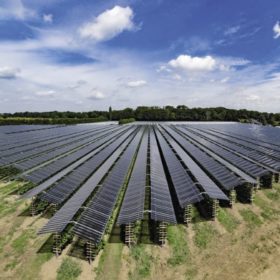
The Italian Council of State has issued new rules to address a number of regulatory gaps, according to lawyer Andrea Sticchi Damiani, who recently won two cases related to agrivoltaic projects. In both instances, the council confirmed that agrivoltaic facilities are distinct from conventional ground-mounted PV plants.
New model to assess effects of shading on crops in agrivoltaic projects
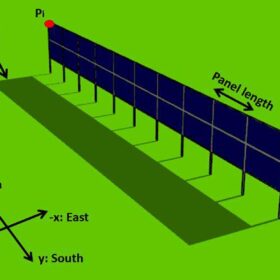
New research shows the importance of calculating the effects of shading created by PV panels on the photosynthetically active radiation (PAR) at the ground level, which is crucial to assessing crop yield in agrivoltaic projects. The proposed modeling considers different agrivoltaic project typologies across several sites in Europe.
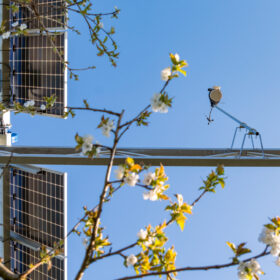
Sun’Agri reveals agrivoltaics performance in heat waves
France’s Sun’Agri has revealed the results of a test showing how agrivoltaic installations effectively lower temperature and relative humidity during periods of drought.
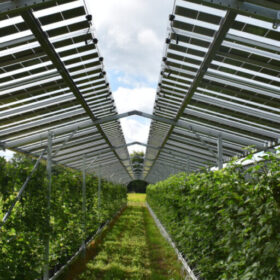
Italian scientific entities publish new regulatory practices for agrivoltaics
Italian scientific institutions have published new regulatory practices for agrivoltaics, with a specific focus on electricity production, agricultural output, and landscape preservation.
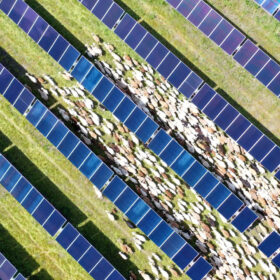
The economics of solar grazing
Researchers at the University of Illinois have conducted a survey, combined with prior research, outlining solar grazers’ investments and earnings. The report also delves into complex grazing business plans on large utility-scale solar facilities.
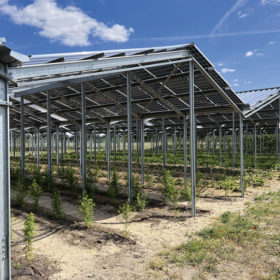
Croatia adopts legal framework for agrivoltaics
The Croatian government has adopted bylaws to the Spatial Planning Act that define agrivoltaic installations and the areas in which they can be deployed, in order to facilitate future deployment.
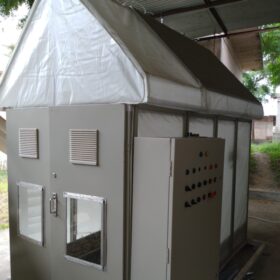
PV-driven controlled farming tech for non-electrified areas
Scientists from India conceived a new system for crop growth in remote areas with no connection to the power grid. It consists of a PV panel, add-on module hardware (AOMH), a battery, step-down DC-DC converters, system power devices, automation, and sensor elements. For climate control, it also comprises a water pump, a ventilation fan for CO2 assimilation, sprinkler foggers, and drop irrigation solenoids.
