
Panasonic glass-based perovskite solar panels tested in office windows
The Japanese electronics manufacturer is testing its glass-based perovskite solar PV technology in office windows made by YKK AP, a construction and building materials company.

Historic icons, modern energy: Why heritage buildings need solar roofing
Heritage buildings face mounting pressure to cut carbon emissions, but traditional solar panels often clash with their historic appearance and face public resistance. Building-integrated photovoltaics (BIPV) offer a discreet alternative, blending solar technology into roofing materials and enabling wider adoption across protected sites. As UK policy increasingly supports solar on historic buildings, BIPV presents a scalable solution that reconciles climate action with architectural preservation.

Sharp offers space-qualified solar cells, plans perovskite-silicon tandem production
The Japanese technology company is offering three types of space-grade compound solar cell designs for satellites and spacecraft.
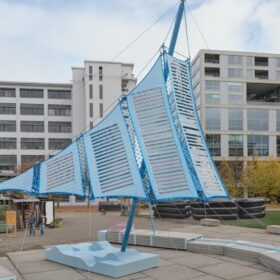
Textile integrated organic solar PV canopy provides shade, area lighting
A novel technical textile integrating 150 organic photovoltaic solar PV devices was demonstrated in a pavilion installation at the Dutch Design Week 2025 in Eindhoven, Netherlands this month.
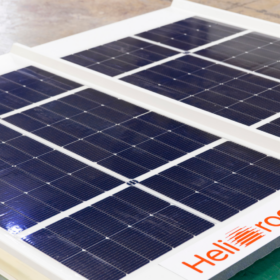
ArcelorMittal starts BIPV module production in France
ArcelorMittal has started producing its Helioroof building-integrated PV modules in France. The steelmaker says the system aims to simplify energy retrofits for commercial and industrial roofs.
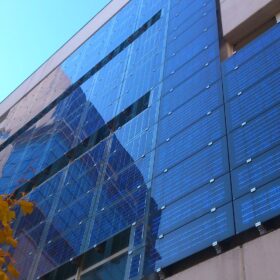
Battery storage boosts viability of south-facing solar facades
Researchers in Germany have examined how battery storage could help façade PV systems move beyond their niche market by 2030. Their findings show that a large majority of south-oriented façades in Europe could be equipped with vertical solar arrays combined with batteries.
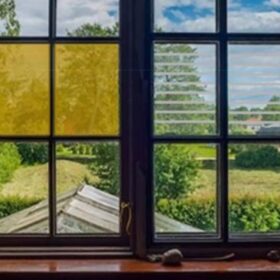
Building-integrated concentrating photovoltaics for vertical applications
An Indian-British research team has developed a building-integrated linear concentrating PV facade by sandwiching an asymmetric compound parabolic concentrator, PERC cells, and encapsulation layers between two sheets of glass. The system was tested under both indoor and outdoor conditions and its payback period was found to be of up to 11 years.

Optimum tilt angle for PV systems ranging from 0° to 90°
A Slovak research team has developed a mathematical model for determining the optimum tilt angle of a solar system ranging from 0° to 90°. Their framework was tested on an experimental setup in Czechia and attained 93.9% accuracy in predicting the system’s energy balance.
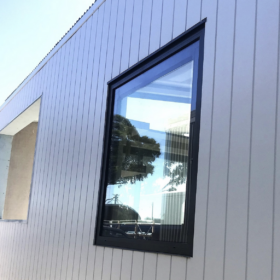
ClearVue unveils Gen3 solar glass with 66% higher energy output
ClearVue Technology says the latest iteration of its solar vision glass delivers more than 66% additional energy output per square metre than its predecessor, while significantly reducing production complexity and costs.
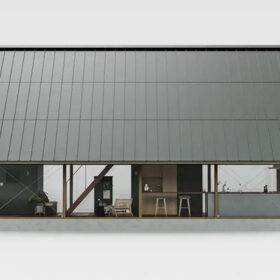
Japanese startup debuts silver-colored BIPV solar module
The new product weighs 13 kg/m2 and is claimed to be particularly suitable for building facades. It features a power ouput of 75 W and a junction box with an IP-68 rating.
