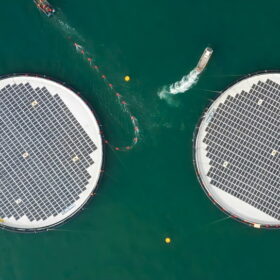
GCL SI presents 480 W solar modules for offshore projects
GCL System Integration (GCL SI) introduced its NT10/60GT floating solar module at the recent SNEC 2025 trade show in Shanghai. It developed the seawater-resistant solution in collaboration with Norway’s Ocean Sun.
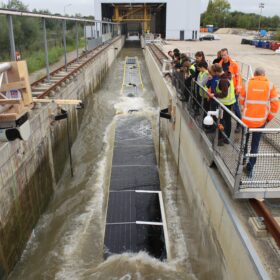
Offshore floating PV enduring world’s largest artificial waves
Offshore PV technologies were tested for the first time under the severe wave loads generated by Delta Flume, a 300 m long man-made flume with a wave generator that is capable of producing waves as tall as five meters. The testing is intended to standardize testing and certification processes for offshore floating PV systems.

High-frequency monitoring of floating PV
Researchers in Brazil have installed a vertical thermistor chain with six temperature loggers beneath a floating PV plant and at a nearby reference site. The system also recorded dissolved oxygen and photosynthetically active radiation to assess environmental impacts.
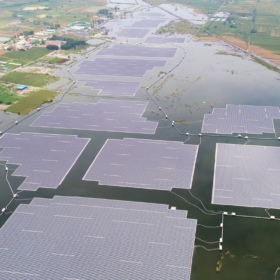
Water-based photovoltaics reach global capacity of 21.18 GW
An international research team has developed an index-based remote sensing method to see trends in the global development of water-based PV. It has found that China currently accounts for 80% of the global total deployed capacity.

Lightsource BP secures financing for 115 MWp fishery solar project in Taiwan
Financial package announcement coincides with groundbreaking ceremony for Project Budai in Chiayi County, Taiwan. The 115 MWp project is expected to be complete in 2026, according to Lightsource BP.
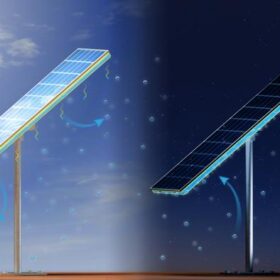
New cooling gel could raise PV module efficiency by 12%
Researchers in Saudi Arabia have developed a hydrogel composite that absorbs moisture in solar modules overnight and facilitates evaporative cooling throughout daylight hours. The system has undergone lab tests and outdoor experiments on two continents.

Floating solar hits $65/MWh LCOE in Brazil, with up to 24 GW of potential
Floating solar could add 17 GW to 24 GW of capacity in Brazil, depending on pricing scenarios, while also reducing water evaporation by up to 50% and conserving water for hydroelectric generation, according to a new study.

Deploying floating PV on mine pit lakes, tailings ponds
Researchers in South Korea have conducted a literature review on recorded cases of floating PV plants placed on mine pit lakes and tailings ponds, both of which are byproducts of the mining industry. Looking at more than dozens of cases, they have concluded that mine pit lakes generally provide more stable environments for deployment.
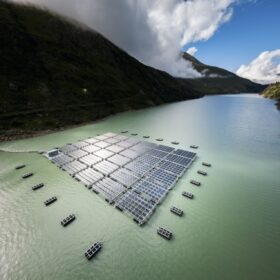
Floating PV systems could increase the climate resilience of lakes
Germany’s Fraunhofer Institute for Solar Energy Systems (Fraunhofer ISE) has conducted new research on the impact of floating PV and water temperature and evaporation.

World’s first offshore wind-solar project moves forward
An offshore solar farm is being deployed close to an existing wind farm as part of a project in the Dutch North Sea. The developers have recently installed an anchoring system that will hold the solar farm in place while an electrical cable connects the array to a nearby wind turbine foundation.
