
Investigating backsheets and ultraviolet stability
Five testing laboratories led by Germany’s Fraunhofer ISE have begun a ‘round robin’ project to test the effects of ultraviolet light on polymer backsheet materials. Initial results indicate a route to accurate accelerated testing of backsheet UV stability over module lifetimes of 20 years-plus.
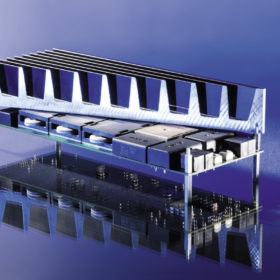
Storage Highlights 2020 – Gigawatt Winner: Fraunhofer ISE
With the new decade, pv magazine brings forth yet another energy storage highlights. Approximately two weeks of work went into sifting through this year’s 22 highlights submissions, conducting research, and preparing them for the jury. Once again, this year’s work was crowned by the moderation of the jury meeting, in which six leading industry experts discussed the technologies and solutions. Differing from previous years, the jurors have selected the top five “Gigawatt” winners, followed by five “Megawatt” winners, and a series of “Finalists” which will be published in the coming weeks, leading up to Energy Storage Europe.

German coal mines could host 3 GW of floating PV
Research institute the Fraunhofer ISE has estimated the technical potential of floating PV at mining sites in Germany at around 56 GW. With floating projects 10-15% more costly than land-based alternatives, researchers have called for further incentives, such as the staging of ‘innovation tenders’.
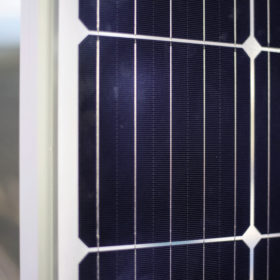
Preventing LID in a 23.83% efficient Longi PERC cell
Australian researchers have unveiled hydrogenation technology to reduce light and elevated temperature-induced degradation in Czochralski silicon PERC solar cells. The developers say the process can minimize degradation without sacrificing performance in cells and modules.
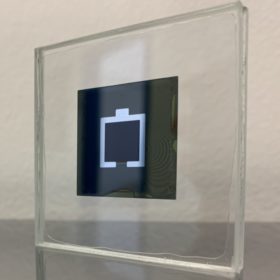
Tandem cells approaching 30% efficiency
Scientists at the Helmholtz Zentrum Berlin have taken back the world efficiency record for a perovskite/silicon tandem solar cell, achieving 29.15% with a device measuring 1cm². The record has been confirmed by Fraunhofer ISE, and according to HZB, this means that the 30% efficiency mark is within reach.

India prepares to embrace agrivoltaics
Take-up has been slow considering the nation’s mammoth agricultural industry but, as a packed session on the topic at the recent Renewable Energy India show illustrated, attitudes may be changing in a nation which is already installing solar greenhouses.
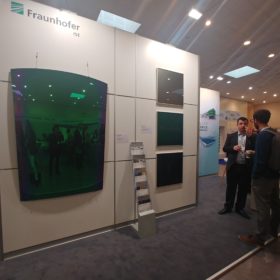
Opportunities for integration: EU PVSEC 2019
Germany’s Fraunhofer ISE is presenting a wide range of solutions for integrated PV – alongside farming, vehicles, the built environment and more, at the 2019 EU PVSEC show happening this week in Marseille.
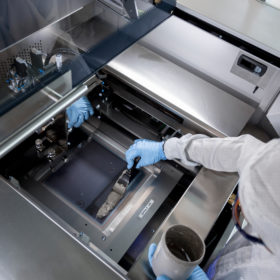
New metallization process cuts silver demand for modules by 30%
Fraunhofer ISE has worked with German technology companies to improve the metallization process in silicon solar cells. The result could drive down module costs quite a bit.
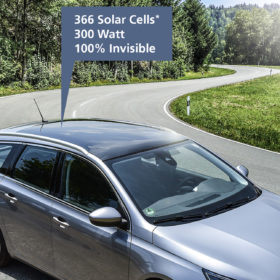
Fraunhofer ISE displays colored solar car roof at auto trade fair
An increasing number of carmakers and research institutes are developing concepts that combine e-mobility and solar. Thus far, range additions from in-car panels of between 10 and 60km are the limit of innovation. The Fraunhofer roof is tinted with a color that hides the cells but lets through most of the light.
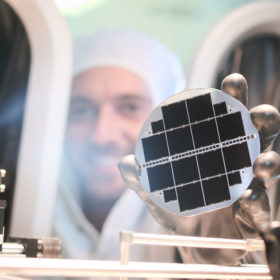
Fraunhofer ISE achieves 34.1% efficiency with triple junction cell
Scientists at Germany’s Fraunhofer Institute for Solar Energy Systems have broken two of their own records for cell efficiency, working with silicon and III-V material tandem cells. The institute hit 34.1% on a triple junction cell using wafer bonding technology and 24.3% by directly depositing III-V layers onto a silicon solar cell.
