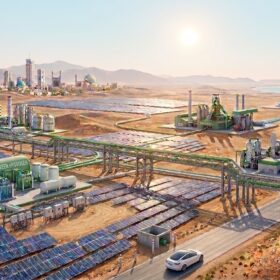
Solar-to-X could redefine Iran’s energy future
Iran is widely known for its oil and gas resources, but its strongest long-term energy asset may be the sun. New research shows how solar PV could drive a cost-competitive transition across power, heat, transport, industry, and desalination, while opening the door to a broader Solar-to-X Economy.

Floating PV could power up to 490,000 households in Hong Kong
Hong Kong has limited land, and researchers have checked how much of the city can be powered if most of its water reservoirs were to be fully or partially covered with floating PV systems. At best, full coverage can supply more than 15% of the city’s total demand, and more than 60% of the residential demand.
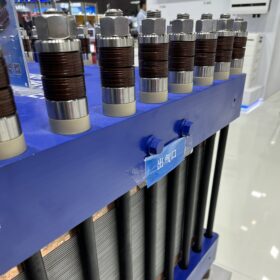
Hydrogen faces ‘year of reckoning’ in 2026, says Wood Mackenzie
Wood Mackenzie’s 2026 market outlook for hydrogen expects non-biological origin hydrogen to gain momentum and ammonia crackers to reach commercial scale but predicts the Middle Eastern market to retreat and the EU to abandon its industrial hydrogen mandates.
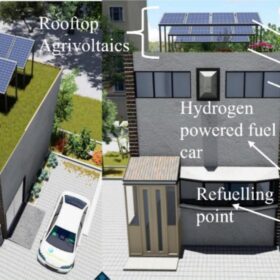
Growing agri-PV tomatoes while producing hydrogen for smart windows
Scientists have simulated a residential building based on a real double-story house in the United Kingdom, combining rooftop agrivoltaics with onsite hydrogen production. Electricity generated by the solar system is used to produce hydrogen, which is then supplied to a hydrogen vehicle and insulated gasochromic smart windows.
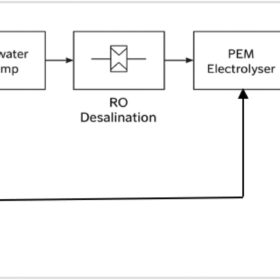
Off-grid floating PV-desalination system for hydrogen production
Scientists have simulated a solar-powered hydrogen production system comprising 32,050 photovoltaic panels, a pumping system, a seawater reverse-osmosis desalination unit, an electrolyzer, and a hydrogen storage tank. Operation of the system in Oman could potentially yield a levelized cost of electricity of $0.05/kWh and a levelized cost of hydrogen of $9.5/kg.
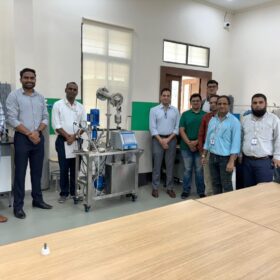
Indian researchers develop stable liquid hydrogen transport system
Researchers at MIT World Peace University (MIT-WPU) in India have developed a liquid organic hydrogen carrier (LOHC) system that enables hydrogen to be transported in a stable liquid form. The system is non-flammable, non-explosive, and can be handled at normal temperatures and pressures.
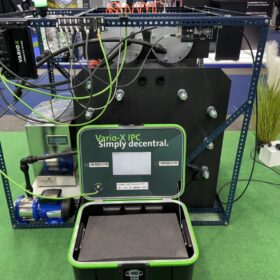
Táctica Industrial unveils off-grid PV system for modular green hydrogen
Spanish renewables specialist Táctica Industrial says its off-grid photovoltaic system produces green hydrogen at about €400 ($470)/kW using modular alkaline electrolysis without inverters or grid connection.
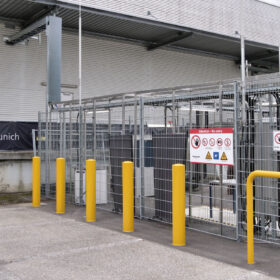
Panasonic testing PV-driven hydrogen platform in Germany
The Japanese conglomerate has deployed its Panasonic HX hydrogen solution at its facility in Munich. The system uses an AI-based energy management system that reportedly makes battery storage unnecessary.
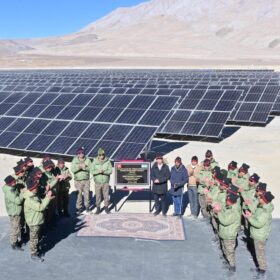
NTPC commissions solar-hydrogen-based microgrid in India
NTPC has developed a standalone solar microgrid system that uses hydrogen as the storage medium to deliver 200 kW of round-the-clock power throughout the year. Designed to replace diesel gensets at off-grid Army locations, the system provides a reliable and sustainable power supply even in harsh winter conditions, where temperatures can drop to –40 C at an altitude of 4,500 meters.

When solar meets next-gen nuclear
Scientists in China have proposed a novel scheduling framework for microgrids based on hybrid PV and a small modular nuclear reactors. The framework uses multi-objective distributionally robust optimization with a real-time reinforcement learning mechanism and is reportedly able to reduce operational costs by 18.7%.
