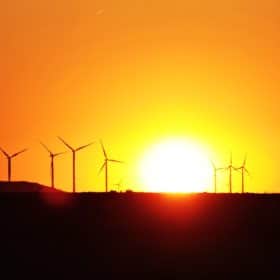
Big interest in Australia’s proposed 1.5 GW solar-wind-hydrogen hub
The Western Australian government has called for expressions of interest for its proposed 1.5 GW solar-wind-hydrogen hub at the Okajee Strategic Industrial Area. This week, it said that 65 companies from around the world are interested.

Improving PV-powered water electrolysis with external fields
Australian researchers have analyzed different ways to improve the efficiency of PV-powered water electrolysis for hydrogen generation. They include the use of magnetic fields, light energy, ultrasonic fields, and pulsating electric fields. Energy costs remain prohibitive, but molecular movement and the redistribution of molecules in water during electrolysis could open a path to viability.
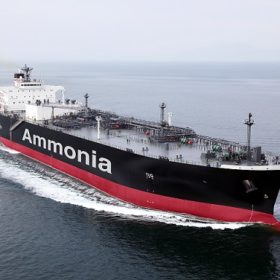
Green ammonia breakthrough a potential boon for solar-powered exports
Scientists from the University of New South Wales and the University of Sydney have made a breakthrough in the development of green ammonia. Their findings could alter the global industry with the help of solar to produce green ammonia for export to countries like Japan and Germany, instead of straight hydrogen.
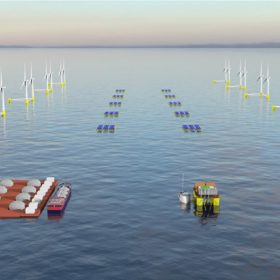
Offshore hydrogen production powered by floating PV
Spain’s Repsol will develop a €4.5 million ($5.5 million) pilot project to produce green hydrogen with floating PV for the Santander Port Authority. It will be completed in December 2023.
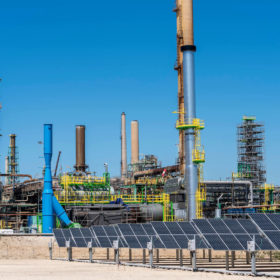
Engie, Total plan 40 MW solar-powered electrolyzer
The two French energy giants have announced a partnership agreement to develop, build and operate the Masshylia project – a 40 MW electrolyzer coupled with solar parks at the Total biorefinery in Châteauneuf-les-Martigues, in the southern region of Provence-Alpes-Côte d´Azur.
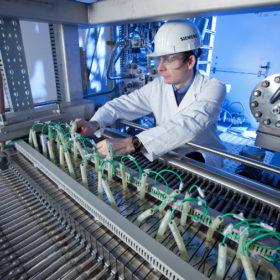
Australia wants to certify green hydrogen with German expertise
The Australian Smart Energy Council and Deutsche Energie-Agentur will work together to develop a scheme to certify renewable hydrogen and carbon-neutral power fuels.
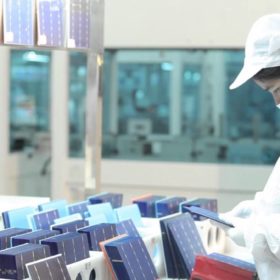
Chinese PV Industry Brief: Jinko begins work on 20 GW cell factory
The solar cell manufacturing facility, located in China’s Yunnan Province, is expected to raise Jinko’s cell capacity to 30 GW by the end of 2021.

Australian iron ore producer, South Korean steelmaker agree to green hydrogen future
Fortescue Metals Group Chairman Andrew ‘Twiggy’ Forrest returned to Western Australia last week after a four-month worldwide search for green energy projects and resources. One of the deals secured on the trip was a circular green hydrogen partnership with South Korean steelmaker Posco.
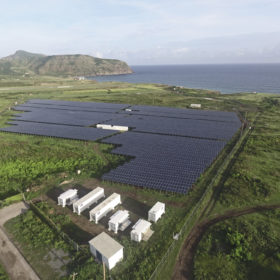
New method to build microgrids based on solar, hydrogen
The use of polymer electrolyte membrane fuel cells as backup power generation in solar microgrids could drive down costs and improve efficiency, according to an international group of researchers. They have proposed a new energy management system that could be ideal for hybrid solar-hydrogen microgrids in remote locations.
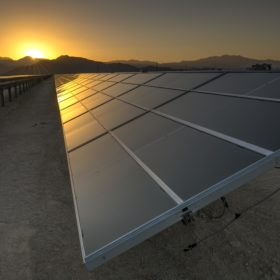
Capacity utilization a key issue in a world energized by renewables and hydrogen
A European research team has investigated the implications of renewable energy intermittency on capital utilization across a future electricity-hydrogen system, including transmission and storage infrastructure. According to its findings, idle capacity substantially increases the system costs and limits wind and solar development.
