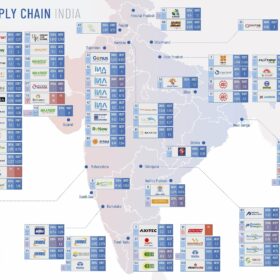
Sinovoltaics maps 68.4 GW of solar module capacity in India
The latest Sinovoltaics solar supply chain report about PV manufacturing in India indicates module capacity of 68.4 GW, cell capacity at 24.5 GW, and ingots at 14 GW, with continued growth planned to 2030.

New PV system sizing approach based on jellyfish search algorithm
Researchers have used the jellyfish search algorithm to optimize solar PV distributed generation placement and sizing. They have tested the algorithm on an IEEE 33-bus system, with one, two, or three PV deployment scenarios, and compared its performance with that of a dozen of competing optimization techniques.

Photovoltaics vs. photovoltaic-thermal
Researchers in India say that photovoltaic-thermal (PVT) systems offer greater performance stability than conventional PV systems in hot climates. Using irradiance and temperature data, the team applied a Random Forest model that predicted efficiency classes with 97% accuracy.

Global PV dataset shows 2019-2022 data
Using Google Earth imagery and 2019-2022 Sentinel-2 datasets, Chinese scientists have developed a two-stage classification framework to obtain the annual global dataset of solar photovoltaic panels at 20-meter resolution from 2019 to 2022.

India adds 25.3 GW of module capacity, 11.6 GW of cells in 2024
Indian manufacturers built 25.3 GW of solar module manufacturing capacity in 2024, taking the nation’s panel capacity to 90.9 GW as of Dec. 31, 2024.

How to reconfigure PV modules in degraded solar plants
Indian scientists have developed six different strategies to reconfigure solar modules in degraded PV assets. Their analysis showed which conditions make the reconfiguration of an underperforming solar plant profitable.

New model to measure wave-induced loss in floating PV
Researchers have developed a three-step technique to estimate power generation loss in floating PV farms resulting from changes in tilt and mismatch losses. The new module was tested in an experimental setup and showed that electricity losses mainly depend both on system design and location.
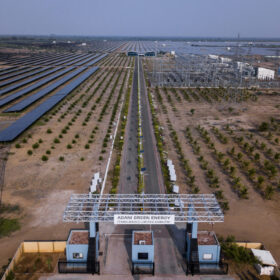
India installs 18.5 GW of utility-scale solar in 2024
India added 18.5 GW of utility-scale solar and 4.59 GW of rooftop PV in 2024. Waaree Energies led the market with a 14.1% share of solar module shipments.

India reaches 74 GW of solar module capacity
India’s solar module manufacturing capacity nearly doubled from 38 GW in March 2024 to 74 GW in March 2025. PV cell manufacturing capacity tripled from 9 GW to 25 GW.

India’s NTPC allocates 1.2 GW wind-solar hybrid capacity at $0.039/kWh
NTPC has awarded 1.2 GW of wind-solar hybrid capacity at an average tariff of $0.039/kWh, with NLC India securing the largest share at 450 MW, followed by Enfinity Global, Welspun Renewable Energy, and Adani Renewable Energy.
