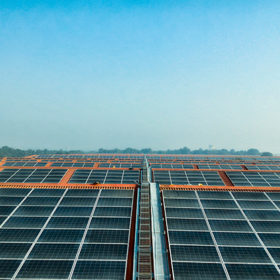
Researchers use artificial neural networks to optimize PV tilt angles
Scientists have tested several machine-learning algorithms to predict the optimal tilt angle (OTA) of solar projects in 37 Indian cities, leading to improvements of up to 90%.
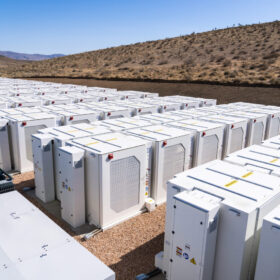
India’s renewable storage capacity to rise by 6 GW by fiscal 2028
Ratings agency Crisil expects India’s renewable energy storage capacity to surge by 6 GW by fiscal 2028, driven by a healthy pipeline.

India allocates 500 MW solar at average price of $0.030/kWh
SAEL Industries, NTPC, and BluPine Energy have emerged as winners in Solar Energy Corp. of India’s (SECI) latest auction for 500 MW of solar capacity, at an average price of INR 2.48 ($0.030)/kWh.

Reducing PV module temperature with water, thermoelectric coolers
Scientists in India have suggested to use thermoelectric cooling to enhance PV module performance. Through a field experiment, they found that thermoelectric coolers combined with water can reduce solar module temperature by up to 38 C.
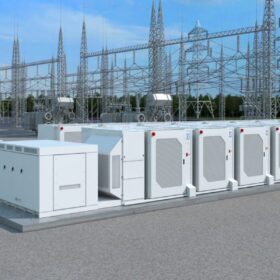
India launches 2 GW solar, storage tender
Solar Energy Corp. of India (SECI) is accepting bids to set up 2 GW of solar PV power projects with 1 GW/4 GWh energy storage systems on a build-own-operate basis. The projects can be located anywhere in India and must be connected to the interstate transmission system.

India can leverage its solar and storage edge to avoid power shortages
Large-scale solar-plus-storage is the main option left to avoid power shortages as such systems can be deployed much faster than new thermal and hydro assets. Recent gigawatt-scale solar-plus-storage auction results, with a record low price of INR 3.40 ($0.04)/kWh, show that such deployment will be highly economical, according to a new study from the University of California’s India Energy and Climate Center.
India allocates 630 MW of renewables-plus-storage capacity at average price of $0.059 /kWh
The winning developers will set up renewable energy projects backed with energy storage system to supply a cumulative 630 MW of firm and dispatchable renewable power in a demand-following manner.

SJVN secures 2.4 GW pumped storage project in India
Indian hydropower provider SJVN said the pumped hydro storage project will be deployed across Darzo Nallah, a tributary of the Tuipui River.
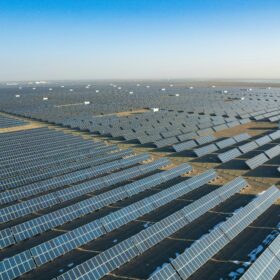
ReNew switches on 400 MW of solar in India
ReNew has completed a 400 MW solar project in western India. The installation is part of a 600 MW power purchase agreement (PPA) with Solar Energy Corp. of India (SECI) for 25 years.

India developers seek tax relief, supply support in new state budget
India’s Union Budget will be presented next week. Developers in the country hope for lower goods and services tax (GST) and import duties on solar components, as well as a delay in enforcing the Approved List of Models and Manufacturers (ALMM) until domestic supplies improve.
