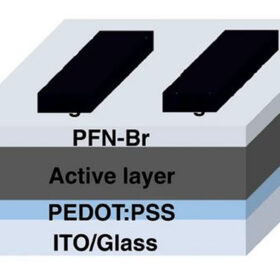
Organic solar cell based on trichlorobenzene achieves 19.31% efficiency
An international research team developed an organic solar cell based on a novel non-monotonic intermediated state manipulation strategy. The device reportedly showed non-radiative recombination losses while exhibiting remarkable power conversion efficiency.
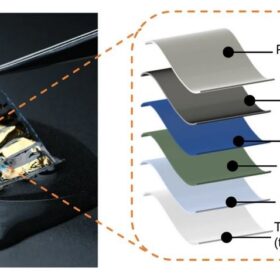
Japanese researchers build 14.3%-efficient bendable, waterproof organic solar cell
Researchers from Japan’s Riken Center for Emergent Matter Science have fabricated an organic solar cell that has achieved waterproofness without reducing flexibility. At 3 micrometers thick, it is thought to be the first cell of its kind to survive a washing machine cycle and retain efficiency after multiple cycles.
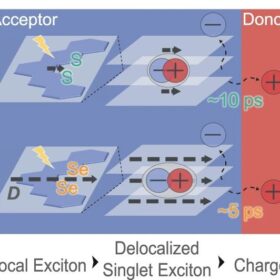
Non-fullerene organic solar cell with selenium acceptor achieves 19% efficiency
Researchers in China have designed an organic solar cell the uses an acceptor based on selenium as an alternative to commonly utilized non-fullerene acceptors. The new acceptor enabled the cell to have reduced non-radiative recombination loss and improved dielectric constant.

Italian startup offers roll-to-roll process for organic solar panels
Ribes Tech, a spinoff of the Italian Institute of Technology, has established a roll-to-roll process to produce organic photovoltaic modules that it says can be expanded to enable volume production of PV modules for indoor sensors, trackers, and electronic devices.

Fraunhofer ISE unveils 15.8%-efficient organic solar cell
Germany’s Fraunhofer ISE has achieved a world record efficiency for organic cells at the lab level. It now aims to bring the PV technology to market maturity.

Binary organic solar cell achieves 19,31% efficiency
Hong Kong Polytechnic University researchers have developed a binary organic solar cell (OSC) with a record power conversion efficiency of 19.31%. They invented a non-monotonic intermediate state manipulation strategy to lower the non-radiative recombination loss and boost efficiency.
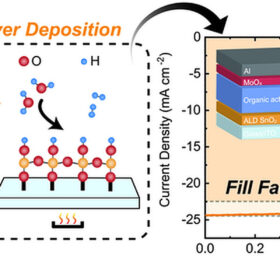
Tin oxide-based organic solar cell hits 17.26% efficiency, 79% fill factor
Dutch scientists have used atomic layer deposition to build an organic solar cell with a tin oxide electron transport layer. This improved electron mobility and transparency, resulting in a record fill factor.
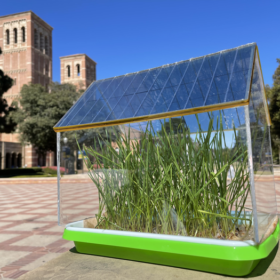
Semi-transparent organic photovoltaics for greenhouse applications
Scientists from the University of California, Los Angeles (UCLA), have used an antioxidant known as L-glutathione as an interlayer in an organic PV cell to prevent other materials from oxidizing. The cell has an efficiency of 13.5% and an average visible transmittance of 21.5%. The researchers said it is suitable for applications in solar greenhouses.
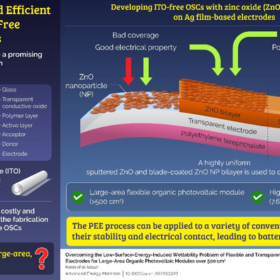
ITO-free organic solar cells for large modules
Researchers in South Korea have reported success in developing large-area, indium tin oxide-free, flexible organic solar cells. Their zinc oxide bilayer-based organic solar cells demonstrated an efficiency of 7.67% for a module area of 528 square centimeters.
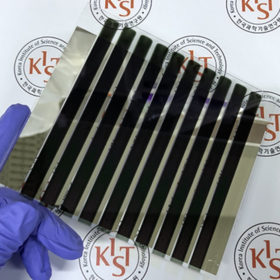
Large-area organic solar cell with 14.7% efficiency
Scientists in Korea built an organic solar cell that is reportedly able to prevent aggregation in photoactive layers. The device could be used for applications in buildings, vehicles, and the Internet of Things.
