
MIT scientists develop perovskite solar cell with 25.2% efficiency
The US researchers claim to have achieved the remarkable result by adding a special conductive layer of tin dioxide bonded between the conductive layer and the perovskite material. They also improved the perovskite layer special additives that do not alter the material’s bandgap.
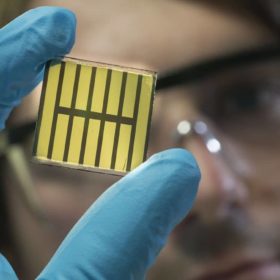
New process to assess quality of perovskite semiconductors
According to German scientists, the quality of the photoluminescence quantum yield of the perovskite layers can be reliably and precisely determined for the first time. It shows that the promising material has more potential for optimization than previously assumed.
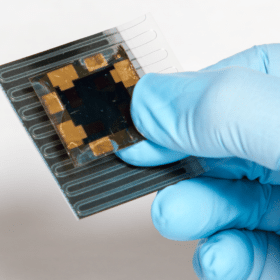
Solliance, MiaSolé hit 26.5% efficiency on tandem CIGS/perovskite solar cell
MiaSolé and Solliance have achieved record performance by optimizing the bandgap and the efficiency of both the rigid semi-transparent perovskite top cell and the flexible CIGS bottom cell.
India joins race to develop high-efficiency solar cells
India’s Ministry of New and Renewable Energy is funding research to develop high-efficiency crystalline silicon solar cells, as well as perovskites.
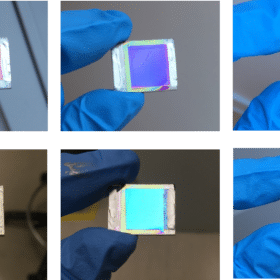
Effective approaches to build colored perovskite solar cells
Scientists in Singapore have conducted a review of all existing methods to produce colorful opaque and semitransparent perovskite solar cells for applications in BIPV and urban environments. They identified two general approaches consisting of coloring the perovskites via external or internal modifications.

Dual passivation tech for 20.14%-efficient perovskite solar cell
Europium ions have been used by Chinese researchers to passivate both the perovskite and electron transport layer (ETL) films of a MAPbI3 perovskite solar cell. As a result, the device’s efficiency was raised by approximately 1.5%. The dual passivation approach also achieved an increase in the cell’s fill factor and open-circuit voltage.
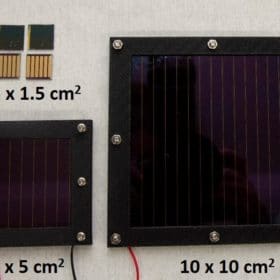
Mini perovskite solar module with 14.55% efficiency
The 5x5cm device was developed by a Japanese research group. The thickness of the perovskite films was increased to reduce defects and pinholes and this was achieved by adding ammonium chloride to the lead iodine solution used in the formation of the films. The device was able to work for 1,600 hours at more than 80% of this efficiency.
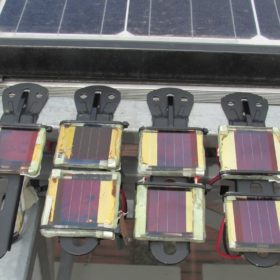
Measuring outdoor performance in perovskites
Scientists in Spain and Colombia took a closer look at the degradation mechanisms affecting perovskite solar cells, and developed a new, high throughput method to characterize their performance in an outdoor setting. The group evaluated the method through outdoor testing on perovskite modules manufactured in a lab. it expects its findings to offer easier device characterization and better understanding of the degradation mechanisms affecting perovskite solar cells, both important factors in the technology’s development.
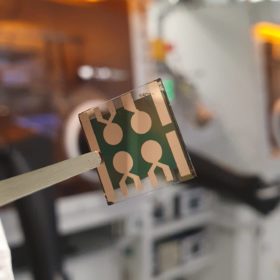
Inverted perovskite solar cell with 21.1% efficiency and high moisture resistance
Australian scientists have built a perovskite solar cell based on 2D and 3D salts. By adding a fluorinated lead salt in the processing solution – normally used to form 3D methylammonium lead iodide – they were able to achieve a 21.1% efficiency, an open-circuit voltage of 1.12 V, a short-circuit current of 22.4 mA/cm2, and a fill factor of 84%.
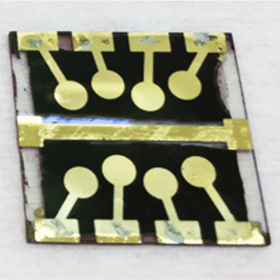
Water-splitting tech to reduce moisture in perovskite solar cells
Italian researchers have engineered a hole extraction layer with water-splitting additives to reduce the impact of moisture in perovskite PV devices. They claim that the method ensured a power conversion efficiency of more than 9% in perovskite cells stored for a month in a water-saturated atmosphere.
