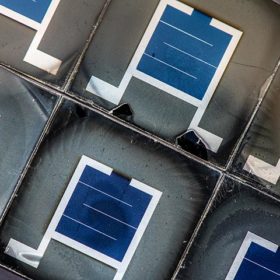
The state of the art in perovskite tandems
A new paper from scientists in China and Canada examines the recent progress in the development of perovskite-silicon tandem cells, finding a technology that’s poised for rapid commercialization, with a few research challenges still to overcome. These are primarily related to ensuring the perovskite layer can match the lifetime of the silicon cell underneath.

Stanford scientists gain insight on polaron distortion in perovskite solar cells
Polaron formation in perovskite solar cells has been indicated in scientific research as a possible factor for making this kind of cell particularly efficient, although the mechanism behind polarons’ action is completely unknown. A U.S. research group has now observed how polaron distortions form and grow.
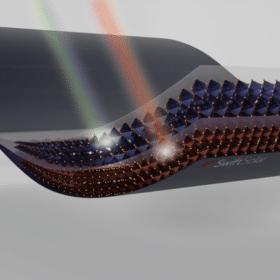
Swift Solar secures financing to expand perovskite R&D
The financing round was led by GitLab CEO Sid Sijbrandij and cryptocurrency expert James Fickel. The company will use the proceeds to expand R&D, develop prototypes and add staff.
Low-cost organic pigment coating for 21.1%-efficient perovskite solar cell
Scientists in the United States have conceived a new process to apply a low-cost organic pigment to perovskite solar cells. The new technique is claimed to increase the efficiency of the devices by around 1.2% and also to improve the cells’ stability.
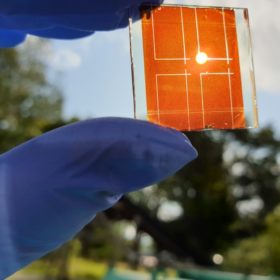
India and Israel to work together on perovskite solar cells and lithium sulfur batteries
Low-cost batteries and novel perovskite materials are among the topics selected for joint research and development.
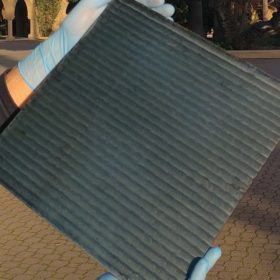
New manufacturing process for 15.5% efficient perovskite solar panels
Stanford scientists have used a robotic device with two nozzles to quickly produce thin films of perovskite. With these films, they have manufactured perovskite cells and modules with efficiencies of 18% and 15.5%, respectively. According to them, this technique may enable the production of perovskite modules at a cost of around $0.25 per square foot.
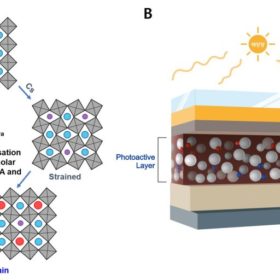
25.17% efficient perovskite solar cell via new photoactive layer
Scientists in South Korea demonstrated a perovskite cell with a certified efficiency of 24.4%. The device is claimed to maintain over 80% of its initial efficiency after 1,300 hours in the dark at 85 degrees Celsius.
New tech to apply perovskite thin-film layers to conventional solar panels
According to its creator, Swedish start-up Evolar, the new technology can be applied to existing production lines for crystalline silicon modules and increase a product’s efficiency by around 5%.

Oxford PV’s German module factory backed by Brandenburg state with €8.8m
Oxford PV is currently building a manufacturing facility for its silicon perovskite tandem solar cells in Brandenburg an der Havel.
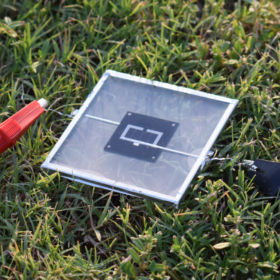
How temperature affects tandem solar cell performance
New outdoor tests conducted at Saudi research center King Abdullah University of Science and Technology (KAUST) have shown that an increase in temperature affects the performance of a tandem perovskite/silicon solar cell not only because of voltage losses but also because of current mismatch between the two sub-cells.
