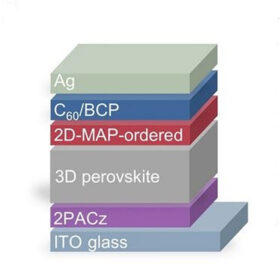
Perovskite solar cell based on 3D/2D heterostructures achieves 26.05% efficiency
Developed by an international team including Saudi Arabia’s KAUST and the Chinese Academy of Science, the solar cell is claimed to be one of the most efficient perovskite PV devices based on 3D/2D heterostructures built to date.
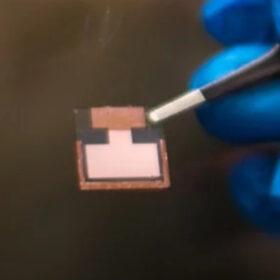
Scientists build 23.2%-efficient lead tin perovskite solar cell with improved lifetime
The researchers built the cell with a hole transport layer (HTL) based on PEDOT:PSS and were reportedly able to reduce the losses caused by this compound with the utilization of a thiocyanate additive. The champion lab-sized device achieved an open circuit voltage of 0.875 V, a short circuit current density of 31.84 mA cm−2, and a fill factor of 83.23%.
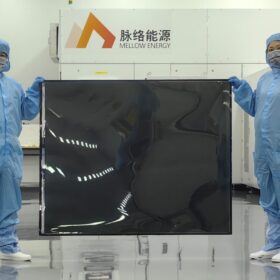
Chinese startup unveils flexible perovskite photovoltaic modules with 15.6% efficiency
Mellow Energy claims its ML-Flex panel is currently the world’s largest flexible perovskite solar module. Available in five versions with power output ranging from 260 W to 300 W, the module measures 1,200 mm x 1,600 mm and weighs only 2.04 kg.

Sekisui Chemical launches pilot perovskite PV projects in Japan
Japanese plastics manufacturer Sekisui Chemical, which recently invested in a 100 MW perovskite solar production plant, announced its latest demonstration project at two sites owned by Japan’s MUFG Bank. The project aims to both raise awareness of practical applications of perovskite solar PV technology and to further verify durability, weather resistance, and performance.

Perovskite solar cell based on hole-selective interlayer achieves 26.39% efficiency
Researchers in China claim to have built a perovskite solar cell that can effictively reduce ion migration and offer superior stability. The device utilizes an ultrathin membrane made of a polymeric material known as PDTBT2T-FTBDT (D18), which reportedly offers conformal coverage on the surface of perovskite film due to its high fluidity.
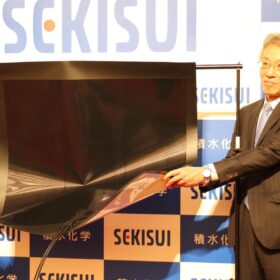
Sekisui Chemical invests in 100 MW perovskite solar production line
Japanese plastics manufacturer Sekisui Chemical is investing in a 100 MW production line to make lightweight perovskite solar panels for low load-bearing rooftops, with an operational start in 2027. It will also acquire a production facility from Japanese electronics manufacturer Sharp.

Chinese developer switches on world’s largest perovskite-based PV plant
MicroQuanta, a Chinese perovskite solar specialist, has commissioned a 8.2 MW PV facility based on its 90 W perovskite panels in eastern China.
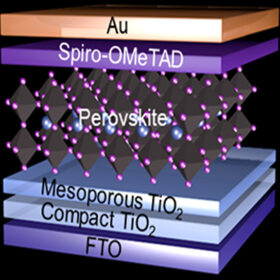
Moisture-resistant perovskite solar cell with 25.14% efficiency
An international research team has fabricated a perovskite solar cell using sulfur-based additives to improve its resistance to moisture. The device not only achieved high efficiency levels but was also able to retain about 96% of its efficiency after 1,000 h.
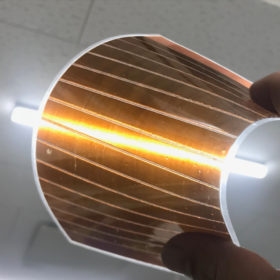
Japan aims to deploy 20 GW of perovskite solar by 2040
The Japanese government says it expects perovskite solar modules to be produced in large quantities at JPY 20 ($0.13)/W by 2025, JPY 14/W by 2030, and JPY 10/W by 2040.
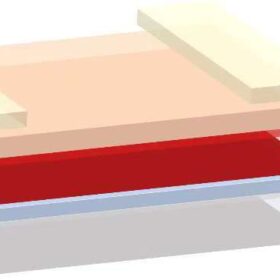
Ultrathin perovskite solar cell based on Gires-Tournois resonator
Scientists in China have conceived a perovskite solar cell that uses a back mirror based on silver to improve light harvesting. The device could reportedly achieved a power conversion efficiency of over 27%.
