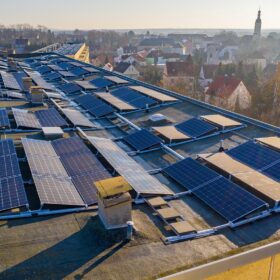
Collectively owned PV systems improve energy community performance
Researchers have looked into the impact of potential regulated charge exemptions on two types of energy communities in 39 European countries. They have found that communities with collectively owned PV systems achieve greater savings.
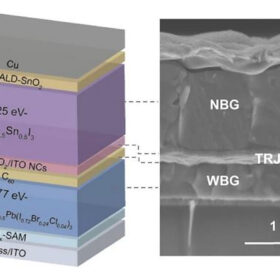
All-perovskite tandem solar cell with 2D/3D heterostructure achieves 28.1% efficiency
A Chinese research team has built an all-perovskite tandem solar cell with a 19.6%-efficient wide bandgap top cell relying on a 2D/3D heterostructure and narrow bandgap bottom cell with a 21.3% efficiency. The tandem device showed remarkable stability by retaining 90% of its initial efficiency after 855 h of continuous operation.
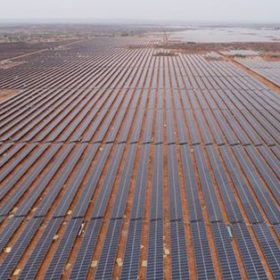
Indian state of Uttar Pradesh to launch tender for 7 GW of solar
The Indian state of Uttar Pradesh says it will soon launch a tender for 4 GW of solar projects, with an additional 3 GW to be auctioned at a later date.
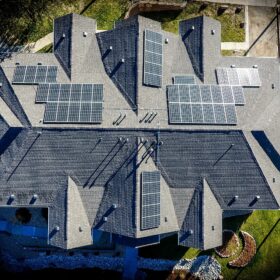
Residential photovoltaic panels with high partial shading tolerance, high voltage
Scientists from South Korea have designed new photovoltaic modules with both rectangular and triangular shapes and solar cells connected in parallel, which they said have higher partial-shading tolerance compared with cells connected in strings. The panels are reportedly less sensitive to partial-shading geometries than shingled modules.

Vertical rooftop PV specialist switches on two more systems on green roofs in Norway
Norwegian vertical solar system specialist, Over Easy Solar, recently supplied a 102 kW bifacial commercial rooftop system, just a few months after supplying a 45 kWp system for a school rooftop. Both systems were installed on so-called green rooftops by the Norwegian project company, Solenergi Fusen.

Sri Lanka launches 70 MW ground-mounted solar auction
Sri Lanka’s government-owned Ceylon Electricity Board (CEB) is inviting applications for the development of 1 MW to 5 MW ground-mounted solar projects – totaling 70 MW – with 20-year power purchase agreements (PPA).
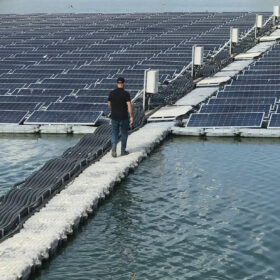
Malaysia launches 30 MW floating solar tender
Kuala Lumpur-based utility Tenaga Nasional Berhad (TNB) has started accepting applications for the development of a 30 MW (AC) floating PV plant at a reservoir in eastern Malaysia.
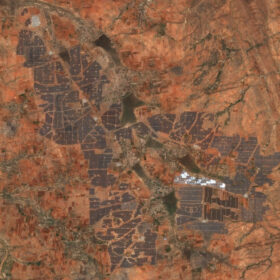
India’s solar installations surpass 72 GW
India’s cumulative solar installations hit 72.02 GW as of Oct. 31, 2023. Grid-connected solar rooftops account for 15.38% of all installed capacity, according to the Ministry of New and Renewable Energy (MNRE).

Saudi Arabia announces 3.7 GW solar tender
Saudi Power Procurement Co. (SPPC) has announced a request for qualification (RFQ) in relation to 3.7 GW of solar across four projects, as part of the fifth round of the Saudi Arabian government’s renewable energy tender program.

Message framing techniques to boost solar sales
A Dutch-German research team has tested how a series of framed messages may be used to boost PV system sales, addressing both self-interest and environmental concerns, and has found that all the proposed messages are effective at promoting the purchase of solar panel installations.
