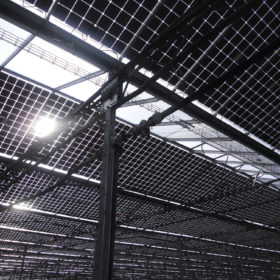
Boosting bifacial panel efficiency with albedo ground covers: Field test results
Tests by 7X Energy show that ground cover material showed promise, but projects will likely still need to prove the long-term durability, degradation rates, and validation of installation labor and O&M.
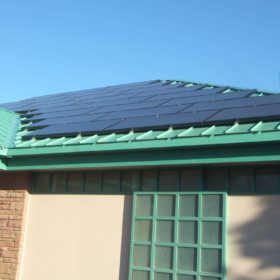
Flexible heat pumps ideal for power grids congested by solar and wind
Dutch transmission system operator Tennet, which also serves Germany, is planning to create flexible electricity demand and reduce grid congestion by promoting the use of smarter heating systems and heat pumps that can also be powered by solar and wind energy. According to its experts, intelligent control of heat pumps may result in the creation of between 0.5 and 1 GW of temporary grid flexibility by 2030.
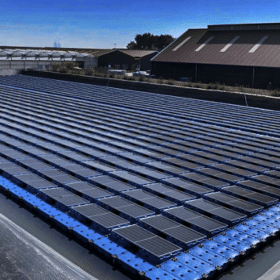
Floating PV plant crossing two adjacent ponds
Spanish developer Isigenere has built a 338 kW floating array on the surfaces of two adjacent ponds in the Netherlands. The plant relies on a special mounting system design that avoids contact between the solar panels and the sides of the pond.

Inverted perovskite solar cell with transition metal carbides achieves 19.2% efficiency
A Russian-Italian research group has developed a two-dimensional transition metal carbide, known as MXenes, to collect photocurrent in perovskite cells. The cells were built with an inverted configuration and are based on a nickel(II) oxide hole transporting layer. The scientists claim that the doping technique allowed them to increase the efficiency of the cell by more than 2%.
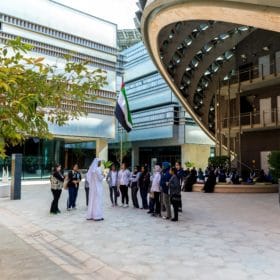
Solar-powered hydrogen for Masdar City
Masdar is launching a pilot green hydrogen project in the United Arab Emirates. In a recent conversation with pv magazine, two company officials described the project and explained how the hydrogen will be used for road transport, aviation and shipping in Masdar City.
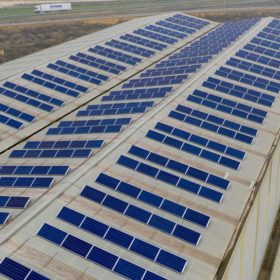
Solar for self-consumption keeps growing in Spain
Around 569 MW of new PV systems were installed last year under the country’s rules for self-consumption. Around 56% of this capacity was deployed in the industrial segment, while commercial installations had a 23% share.
Total Eren and EDF Renewables secure $165 million for 450 MW solar project in India
Developer Eden Renewables India won the project, currently under construction in Rajasthan, in a Solar Energy Corporation of India (SECI) auction.

Tesla sharpens focus on solar
In an earnings call this week, Tesla CEO Elon Musk boldly claimed that the company will soon be “the market leader in solar.”
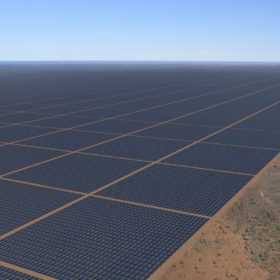
Major milestone for world’s biggest solar project
The world’s biggest solar+storage project is a step closer to realization, as the government of Australia’s Northern Territory and Singapore-based Sun Cable have signed a deal to advance the development of the Australia-ASEAN Power Link.
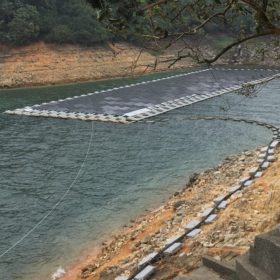
Large scale floating PV to sell power at $0.0368/kWh in Indonesia
A new report from the Institute for Essential Services Reform (IESR) shows that PV has not been growing significantly in Indonesia in recent years, despite the size of its energy market and economy. According to its authors, however, there are multiple paths that can be followed to bring volumes into all market segments. Large scale solar is expected to play a major role in the years to come, as the LCOE for big floating projects is approaching levels close to those of more mature markets.
