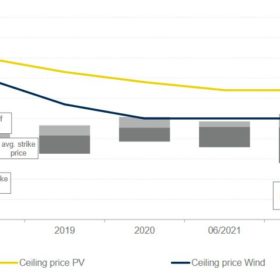
Latest Polish renewables auction shows momentum of unsubsidized solar
Recent analysis from German consultancy Enervis has shown that only 40% of the electricity to be generated by solar capacity in Poland’s latest auction for utility scale renewables will be sold under the exercise’s contracts for difference regime, and that the remaining share will be sold under bilateral power purchase agreements or to the spot market.
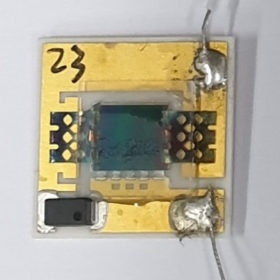
Multi-junction solar cell integrating radiative cooler
The triple-junction solar cell is based on indium gallium phosphide (InGaP), gallium arsenide (GaAs), and Germanium (Ge) and is made with a micro-grating made of glass, consisting of a two-dimensional x-framework structure fixed onto the surface of the solar cell. Its operating temperature was found to be 6 degrees Celsius lower than that of a reference cell without the cooling technique.
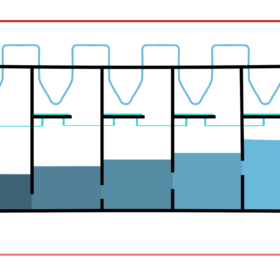
Photovoltaics for multistage flash desalinators
Scientists have investigated how utility-scale solar may be used to power multistage flashing-brine recirculation (MSF-BR) water desalination plants in Aqaba, Jordan. They found the facility would be sufficient to provide the entire city with drinking water. The proposed system configuration comprises a 30 MW solar plant and a standar MSF-BR unit.
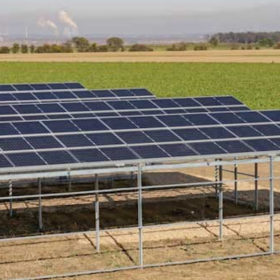
New agrivoltaic system design from Germany
Germany’s Sunfarming is testing the new project design in cooperation with research centers Jülich and the Fraunhofer ISE.
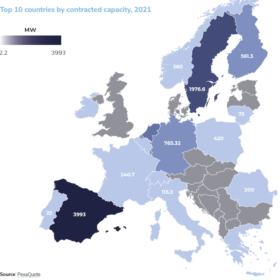
Spain largest PPA market in Europe last year with almost 4 GW of deals
According to Swiss consultancy Pexapark, around 11 GW of power purchase agreements were closed in Europe last year. For 2022, the analyst expects shorter deals and the presence of more new entrants.

Chinese PV Industry Brief: GCL-Poly wants to move to Shanghai Stock Exchange
In other news, Longi raised funds to build another 18 GW of solar cell capacity and Suntech began work on its 10 GW module factory in Anhui Province.
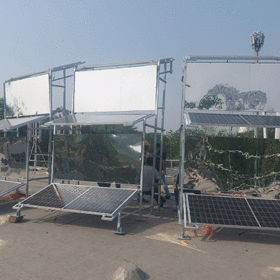
Portable, space-saving photovoltaic towers
Researchers at the Indian Institute of Technology Delhi have developed solar towers that can be moved from one place to another and can generate 20-30% more power while requiring only 50-60% space compared to conventional mounting setups.
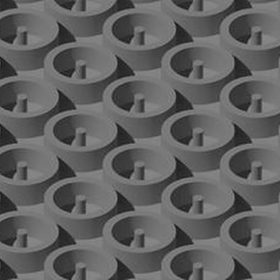
Subwavelength antireflective structure for thin-film solar cells
Consisting of a two-dimensional (2D) array of rings and pillars, the structure can improve the short-circuit current of a thin-film crystalline solar cell by over 50%, its creators say. The subwavelength AR structures are robust to certain degrees of fabrication errors, they add.
Tapping the offgrid solar market in India
Ashutosh Verma, the founder of solar appliance manufacturer Exalta India, says that the key to expanding the uptake of solar products in rural parts of India lies in improving access to finance.
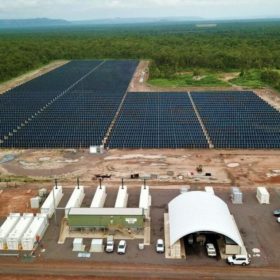
Solar-plus-storage powers Australian mining town
The remote Australian township of Jabiru, deep in the heart of Kakadu National Park, has been powered 100% by solar PV during the final commissioning of the new Jabiru Hybrid Renewable Power Station.
