
UN invests $700,000 in 120 kW hybrid solar plant in DR Congo
The United Nations Development Program (UNDP) has invested nearly $700,000 to build a 120 kW hybrid solar plant in Mambasa, Democratic Republic of the Congo. The community PV project will supply power to more than 300 users, including six health centers, 224 small businesses, and 89 households.

Germany could deploy 10 million heat pumps by 2030
Scientists have used open-source models to simulate heat pump rollout scenarios for the year 2030. Additional investments of around 54 GW to 57 GW of solar PV capacity in a least-cost solution would allow the installation of 10 million heat pumps by the end of the decade.
How to combine off-grid agrivoltaics with large-scale hydrogen production
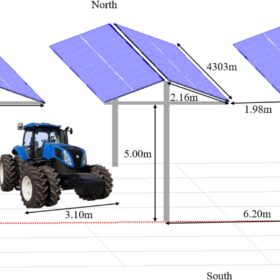
Scientists in the United Kingdom have simulated how a 1 GW off-grid agrivoltaic facility may be used to fuel hydrogen fuel electric cell vehicles across Australia, California, China, Nigeria, and Spain. Their techno-economic analysis showed that the proposed combination could provide a levelized cost of hydrogen ranging from $3.90/kg to $8.13/kg.
Panasonic powers UK factory with solar-driven hydrogen fuel cell generators
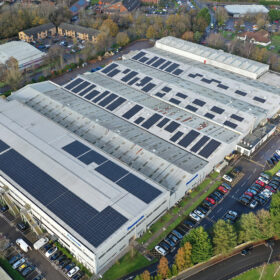
Panasonic has launched a solar-powered hydrogen fuel cell project at its factory in Cardiff, Wales, with the microwave assembly now operating on renewable energy.

Huge Energy unveils new mounting system with patented clamp design
China-based Huge Energy has launched a new mounting system featuring a patented clamp design. The system, made from Zn-Al-Mg coated steel, supports concrete and pile foundations.

ADB commissions 500 kW solar project with 2 MWh of storage in Tuvalu
The Asian Development Bank (ADB) has commissioned a 500 kW solar rooftop project in Tuvalu’s capital, Funafuti, along with a 2 MWh battery energy storage system (BESS).
Australian utility switches on solar farm built for cyclonic conditions
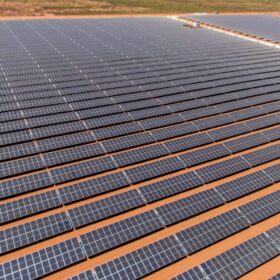
APA Group has officially opened a solar project, designed to withstand sustained wind speeds of almost 300 kph, along with a co-located battery energy storage system in Western Australia’s Pilbara region.

Czech electricity grid to get €400 million upgrade
The European Investment Bank (EIB) has granted a €400 million ($420 million) loan to Czech utility ČEZ to upgrade and expand Czechia’s electricity distribution grid. The upgrades are expected to help absorb up to 5.5 GW of new renewable capacity.

Agrivoltaics for peppers
Scientists have built in India a 1.8 kW agrivoltaic setup to grow peppers under the PV modules. The proposed project design is described as an agrivoltaic insect net house that could be use for all crops that require rigorous pest management.
Enphase Energy rolls out software to prevent busbar overload
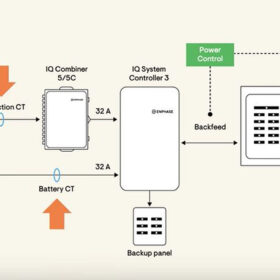
Enphase Energy has released new software to help homeowners install larger solar and battery systems without major electrical panel upgrades. It uses real-time measurements from current transformers to make immediate decisions.
