
Researchers propose new taxonomy for agrivoltaics
A Malaysian research team proposed new concepts such as cowvoltaics, sheepvoltaics, goatvoltaics, veggievoltaics, fruitvoltaics and fishvoltaics to better define the diverse applications of photovoltaics in dual land use. Their review outlines four main categories – livestockvoltaics, crop-based agrivoltaics, aquavoltaics, and zoovoltaics – and presents several business cases.
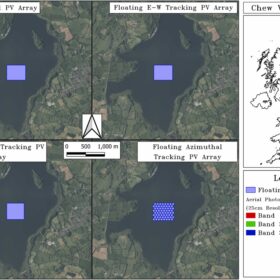
UK study finds azimuthal trackers boost floating PV performance
A University of Exeter team has tested single-axis tracking systems for floating solar across 12 UK sites, finding azimuthal tracking delivers the largest energy gains and lowest levelized cost of energy (LCOE).
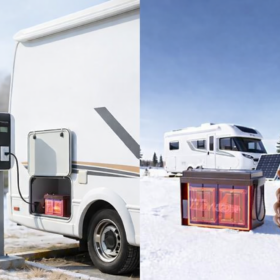
LiTime launches 320 Ah LiFePO4 battery with 4,096 Wh capacity
Chinese battery maker LiTime has introduced its 12V 320Ah Mini Smart Self-Heating Battery, offering 4,096 Wh of energy capacity and 2,560 W of continuous output power.

Beyond technology: Reshaping the gender equality narrative for the energy transition’s Success
This week, Women in Solar+ Europe brings together voices from the 2025 series analysing the critical factors needed to advance gender equality across our solar plus industries. From visibility and bias to leadership accountability and allyship, these reflections reveal why advancing inclusion is essential to a successful energy transition.
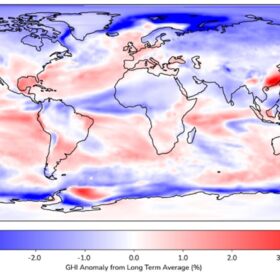
Early Solar forecast: First half 2026 solar outlook
In a new weekly update for pv magazine, Solcast, a DNV company, reports that early 2026 will bring mixed solar conditions globally, with strong prospects in eastern Australia and eastern China, but cloudier-than-normal outlooks for much of Europe, Asia, and parts of the US early in the year.
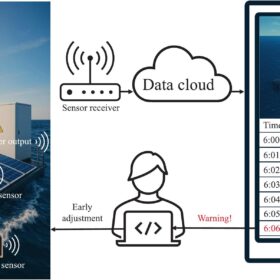
New digital twin for floating PV application uses artificial intelligence
Scientists have developed a floating PV digital twin system, trained on data from 155 physical experiments, using a two-tier artificial neural network (ANN) with a high-fidelity model and a reduced-order model. Predictive performance reached R2 values of 0.9996 for PV surface temperature and 0.9189 for power output.
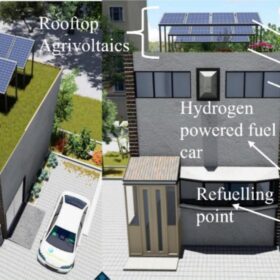
Growing agri-PV tomatoes while producing hydrogen for smart windows
Scientists have simulated a residential building based on a real double-story house in the United Kingdom, combining rooftop agrivoltaics with onsite hydrogen production. Electricity generated by the solar system is used to produce hydrogen, which is then supplied to a hydrogen vehicle and insulated gasochromic smart windows.

CATL confirms significant upgrade to sodium-ion battery product range and scale into 2026
CATL announced it expects a new trend of “sodium and lithium batteries shining brightly together.”
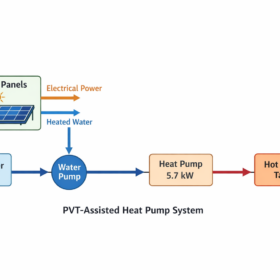
How to improve indirect-expansion PVT-assisted heat pump performance
Scientists in Thailand have simulated an indirect-expansion photovoltaic-thermal-assisted heat pump and measured its performance under various cold water temperatures and tank sizes.
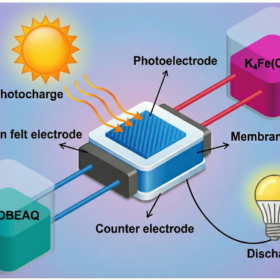
PV redox flow battery with 4.2% solar-to-electricity conversion efficiency
Scientists in China have constructed and tested a device that uses redox couples paired with a single triple-junction amorphous-silicon photoelectrode. When tested under a xenon lamp simulating one sun, the device achieved an average solar-to-electricity conversion efficiency of 4.2%.
