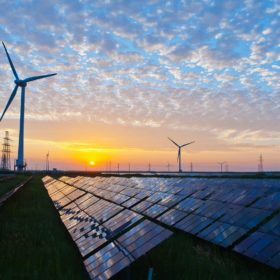
Choosing the right sites for Indian renewables
With biodiversity concerns and social impacts such as arguments over the loss of agricultural land delaying projects, non-profit The Nature Conservancy India has published a report to help developers choose their locations more carefully and get India’s energy transition back on track.
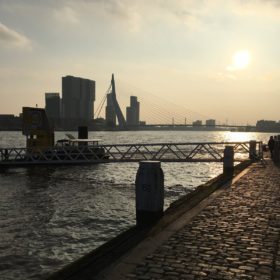
Netherlands allocates 3.44 GW of PV in spring round of 2020 SDE+ program
The Dutch government awarded 3.91 GW of renewable-energy capacity in the program’s latest round. It set aside €4 billion for the exercise, but only used €3.3 billion, including €2.1 billion for PV.
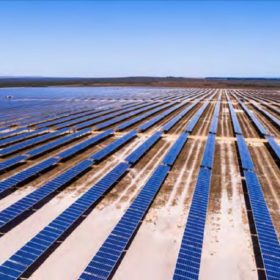
Western Australia seeks proposals for 1.5 GW of green hydrogen
The Western Australian government is talking to developers around the world about building a 1.5 GW wind and solar hydrogen hub at the Okajee Strategic Industrial Area. The state’s Mid West region has some of the world’s best solar and wind resources and they could drive the development of a local green hydrogen economy.
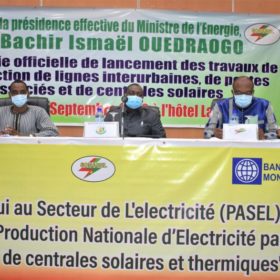
Construction begins on 30 MW of solar in Burkina Faso
Work has started on PV plants with generation capacities of 20 MW and 10 MW. The facilities will be located in Koudougou, in Boulkiemdé province and in Kaya, in Sanmatenga, respectively.
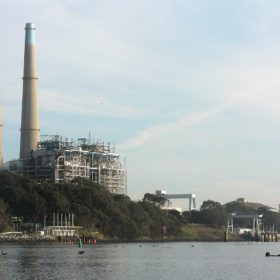
How does the US retire 236 GW of coal and 1,000 gas peaker plants?
Victory in the economic realm (increasingly the case with solar, solar-plus-storage and wind) is no guarantee of market victory if the regulations are stacked against renewables.
Power-to-hydrogen for multi-energy systems
Scientists in Switzerland say power-to-hydrogen is particularly promising for coupling electricity and heating and offsetting seasonal variation in renewables generation in sector-coupled energy networks. Their analysis indicated the technology may be especially useful in areas with a high ratio of seasonal thermal-to-electric demand.
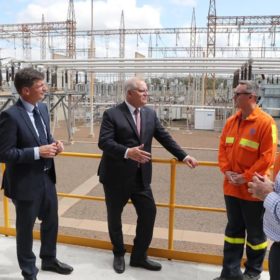
Australian government reduces support for solar, wind
The Australian government has announced new long-term funding and an expanded remit for the Australian Renewable Energy Agency beyond 2022. The funding package, which looks more like a cut than anything else, pushes investment away from solar and wind toward technologies like carbon capture and storage.
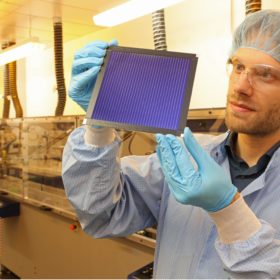
New world record for large-area organic PV module efficiency
Scientists in Germany have achieved 12.6% efficiency with a 26 sq cm organic panel and 11.7% for a 204 sq cm device. The feats were achieved with a new module layout and a slower, high-resolution, short-pulse laser structuring process.
South Africa to tender 6.4 GW of solar and wind, 513 MW of storage and 4.5 GW of conventional generation
The country’s regulator has approved a government plan to tender for 11.81 GW of power generation capacity on top of the 2 GW tender opened last month.
Bulgaria wants another 2.6 GW of renewables by 2030 – and coal
The government’s energy strategy targets new clean energy capacity this decade but all existing coal power plants will also remain active, gas pipelines could be upgraded and new nuclear facilities deployed.
