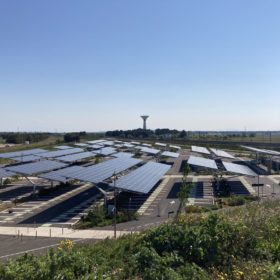
French rail operator launches tender for 156 PV carports
French state-owned railway operator SNCF plans to install 1.1 million square meters of solar modules at its train stations by 2030. Developers interested in its new solar carport tender have until April 15 to submit their project proposals.

New flexible solar module factory begins operations in the UK
Operated by UK start-up Power Roll, the pilot factory will reach a capacity of 30 MW by year end. The manufacturer uses low-cost roll-to-roll manufacturing processes and patented microgroove patterns to produce flexible solar panels intended for applications on warehouses and agricultural sheds whose roofs are not strong enough for conventional arrays as well as in vehicle-integrated photovoltaics.

More than 190,000 plug-in PV systems are now online in Germany
A recent report from HTW Berlin and Verbraucherzentrale NRW reveals that, between 2020 and 2021 alone, around 128.000 new plug-in solar arrays, totaling 51MW of generation capacity, were installed in Germany.

The best BIPV envelope design alternatives
Scientists in Australia have developed an optimization framework for building-integrated photovoltaics that allows the selection of design variables according to user preferences. Their model considers PV-related features such as tilt angle, window-to-wall ratio (WWR), PV placement, and PV product type, as well as objective functions and constraints such as the net present value and the payback period.
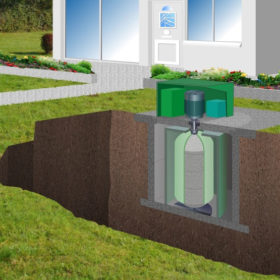
French flywheel storage system specialist secures €10 million investment
Madagascar-based Filatex has invested €10 million in French flywheel storage system manufacturer Energiestro. The two companies are planning to deploy Energiestro’s flywheel storage solutions across Madagascar and Mauritius
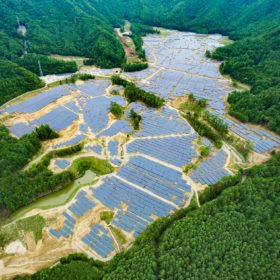
Japan unveils 2022 feed-in tariff levels for PV
The Japanese government is proposing 20-year FITs lower than $0.010/kWh for rooftop PV and a ceiling price of $0.087/kWh for solar energy auctions. These incentive levels will likely be insufficient to stimulate demand given rising solar project costs.

LG to close US solar module manufacturing facility
The closing of the Alabama-based facility comes in tandem with the announcement that LG will be folding its solar module business by the end of June.
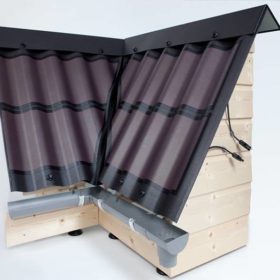
Solar foil for BIPV applications
HyET Solar and the Delft University of Technology are developing a photovoltaic foil technology that is claimed to be suitable for any type of surface. The solar foil has a 12.0% conversion efficiency and is based on hydrogenated amorphous silicon and nanocrystalline silicon in a tandem cell configuration.

LG exits solar module business
The Korean manufacturer said its solar module business will be closed by the end of June. It blamed uncertainties in the global solar industry for its decision.
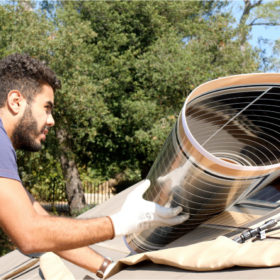
Rollable CIGS solar modules from France
French start-up Solar Cloth is planning to scale up capacity at its module production facility near Cannes. The factory will produce 17.6%-efficient flexible solar modules integrated into textile supports.
