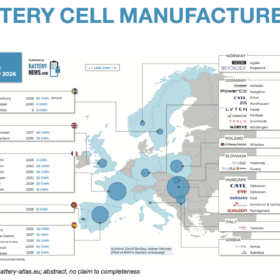
‘Battery Atlas 2026’ maps Europe’s cell, pack and battery manufacturers
The “Battery Atlas 2026” report shows consolidation in Europe’s battery market. More than 2,000 GWh of cell production capacity was announced in 2023, but the realistic forecast for early 2026 is around 1,190 GWh, including approximately 673 GWh led by Asian companies.
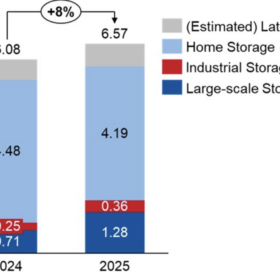
Germany adds 6.57 GWh of battery storage in 2025, total hits 24 GWh
Germany added an estimated 6.57 GWh of stationary battery storage capacity in 2025, an increase of about 8% year on year, lifting total installed capacity to roughly 24 GWh. Growth was driven by industrial and large-scale systems, even as home storage installations declined alongside weaker rooftop solar demand.
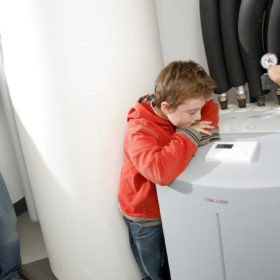
Heat pump plus PV usually cheaper than gas heating after 11 to 14 years
An analysis by Eon and Aachen University shows how quickly heat pumps with and without photovoltaic systems and storage pay for themselves in different types of homes, also in comparison to gas heating. A heat pump with photovoltaics is usually more economical than without. Balcony solar usually pays for itself in three to six years. An accompanying survey shows that most people underestimate the economic viability of climate-friendly energy technologies.
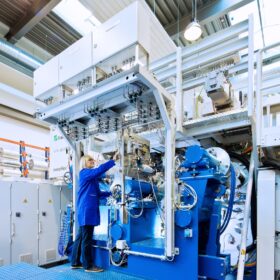
High-efficiency electrodes with ultralight current collectors
Eight industrial and scientific entities in Germany have come together to pursue two key innovations in lithium-ion battery technology: the replacement of metal foils with a metallized fabric structure, and the use of silicon as anode material.
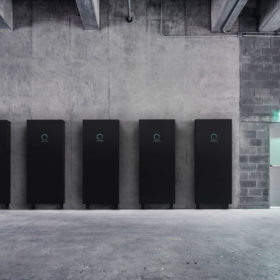
Growing German storage market buoyed by falling prices
RWTH Aachen University and Forschungszentrum Jülich evaluated the data. It shows a growing demand for photovoltaic storage systems in 2019 and continued positive market sentiment lasting well into 2020.
