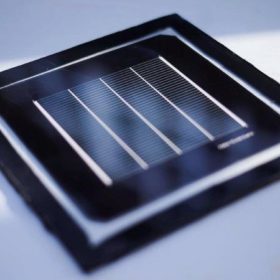
Meyer Burger to commercialize 29.6%-efficient perovskite tandem solar cells
Meyer Burger is working with several research institutes in Switzerland and Germany to integrate perovskite tandem technology into its manufacturing processes.
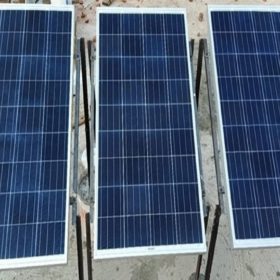
Hydrophobic nanocoating to reduce soiling in solar panels
Scientists in Egypt have created a self-cleaning, hydrophobic coating for solar panels that reportedly increases their efficiency by more than 30%. They used a coating solution based on polydimethylsiloxane (PDMS) and silicon dioxide (SiO2) nanocomposites, mixed with ethanol and isopropanol.

Solar Inventions gets patent for silver-saving configurable current solar cells
Solar Inventions has patented technology that could save between $2 million and $5 million per gigawatt in solar projects, while also raising rated power output. The company has patents in the United States, China and Israel for its cell configuration.
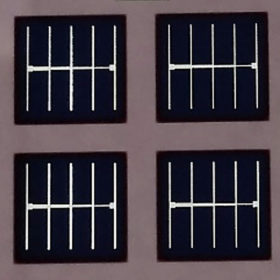
Heterojunction germanium solar cell with 8.6% efficiency
Japanese scientists have developed a heterojunction germanium solar cell with the biggest area ever achieved for the tech. It has an open-circuit voltage of 291 mV, a short-circuit current of 45.0 mA/cm2, and a fill factor of 0.656.
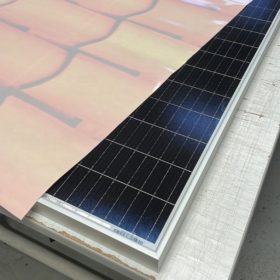
Customizable sticker to turn solar panels into advertising billboards
An Italian startup has created a fully recyclable sticker that can be used to cover solar panels on rooftops or facades. It replicates high-definition images that can help to improve the aesthetics of solar arrays or turn PV facades into advertising billboards.

Australian researchers patent additive for perovskite’s stability problem
University of New South Wales (UNSW) researchers in Australia have discovered a low-cost way to stabilize perovskite solar cells with a triple function additive. Perovskite cells have shown the best stability results with it so far.

EU aims for 30 GW of solar module production by 2025
The European Commission has launched the EU Solar PV Industry Alliance. SolarPower Europe has already joined the new entity, while EIT InnoEnergy said it will act as its secretariat.
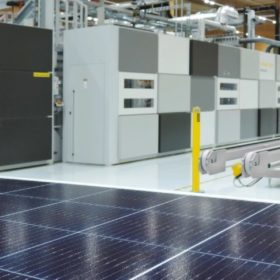
Energetica resumes solar module production
Austrian module manufacturer Energetica has restarted production, following its acquisition by IRMA Power.
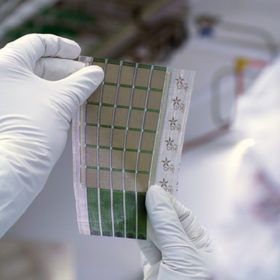
MIT scientists produce new organic photovoltaic fabrics
US researchers have developed a thin-film organic solar module on a vapor-deposited releasable substrate made of parylene. The device could be used as a wearable fabric, or to bring solar generation to remote locations.
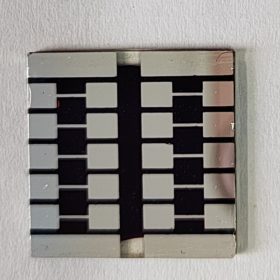
Inverted perovskite solar cell with 22.15% efficiency, 83.92% fill factor
Chinese scientists have used daminozide as an interlayer and additive to make a perovskite solar cell with a p-i-n structure. It has the highest efficiency and highest fill factor for a polycrystalline, MAPbI 3-based inverted perovskite solar cell to date.
