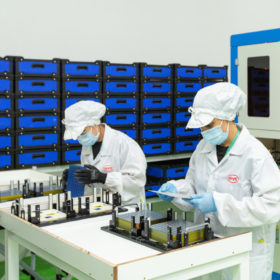
BYD to produce 22.2% efficient n-type TOPCon solar modules in Brazil
The Chinese manufacturer said the modules will have a nominal power of 575 W and a temperature coefficient of -0.32% per C.

Indian government approves second phase of solar manufacturing incentive scheme
The Indian cabinet allocated around $2.4 billion for the second phase of the incentive scheme.

Vehicle-integrated solar kit may reduce frequency of recharging by 14%
Developed by the French research institute Liten, the prototype kit consists of a 145 W photovoltaic panel, a magnetic rear panel, and an MPPT charge controller. It also includes a battery and a micro-inverter that can be used to inject the stored energy into the grid when the vehicle is recharged.

Inverted perovskite solar cell achieves 22.31% efficiency via novel electron-accepting interlayer
A Korean research group has built an inverted perovskite cell that is able to retain 91.7% of its initial efficiency after 1,000 h under standard illumination conditions. They built the device with an electron-accepting interlayer that also acts as charge transport.
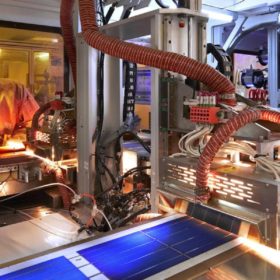
Chinese PV Industry Brief: Trina buys 70,000 MT of polysilicon from South Glass Group
In other news, a Chinese consortium is planning to build a 10 GW heterojunction (HTJ) module factory in Sichuan and Risen Energy is seeking to raise around $1 billion through a private placement of shares to finance its 5 GW HTJ panel production.
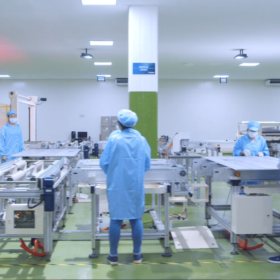
Latin America may host three more solar factories
Mexican solar manufacturer Solarever said it wants to invest $1 billion in a new factory in Jalisco and Brazilian PV system provider Sengi Solar said it aims to set up two manufacturing facilities in the states of Paraná and Pernambuco.

Cadmium-free kesterite solar cell with 9.7% efficiency
Researchers in China developed a new kesterite solar cell they say has improved efficiency and stability. The device was able to retain around 90% of its initial efficiency after 100 days without encapsulation.
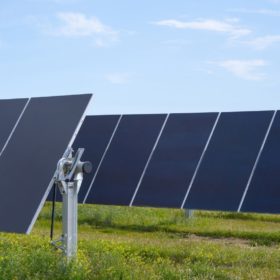
First Solar secures 600 MW order for ‘made-in-India’ PV modules
US manufacturer First Solar will supply its thin-film panels to Indian developer Azure Power.
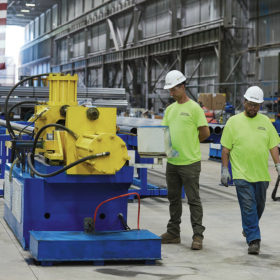
A new era of made-in-USA solar
There are both challenges and benefits to boosting solar manufacturing in America. The Inflation Reduction Act of 2022 includes a host of measures to support the production of US renewable energy technologies and could foster a new era for made-in-America solar. pv magazine USA Senior Editor Anne Fischer explores the current status and outlook of US solar manufacturing.
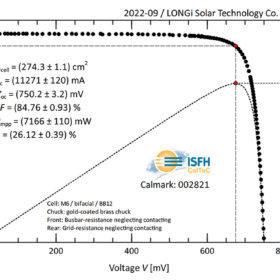
Longi achieves 26.12% efficiency for gallium-doped p-type heterojunction solar cell
The result, confirmed by Germany’s Institute for Solar Energy Research Hamelin (ISFH), was achieved on a heterojunction solar cell based on an M6 wafer.
