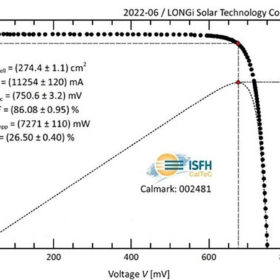
Longi’s heterojunction solar cell hits 26.5%
Germany’s Institute for Solar Energy Research Hamelin has confirmed that Longi’s new n-type heterojunction solar cell has achieved a power conversion efficiency of 26.5%.

Perovskite solar module march continues with 30-year ‘no thickness’ layers, speed testing
Princeton University researchers have developed a new way to accelerate solar cell longevity testing.

Okra Solar secures funding to bankroll mesh-grid expansion
Australian renewables startup Okra Solar has raised $3 million to scale up distribution of its solar-based hardware and software solutions. It aims to electrify more than 290,000 off-grid homes in Nigeria over the next three years, while also expanding its operations in countries such as Haiti.
RETC releases 2022 Module Index Report
The Renewable Energy Test Center has released a new report on PV module performance.
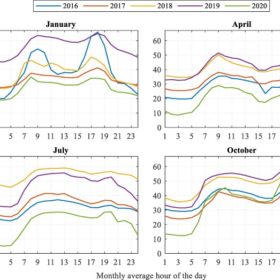
Debunking myths about PV system orientation, dimensioning
New research from LUT University shows that there is no single correct orientation for a PV installation.
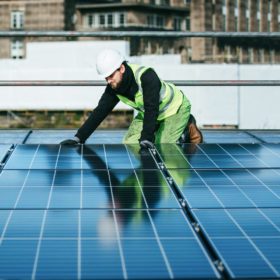
Consortium to spend $6 billion on US solar modules
AES, Clearway Energy Group, Cypress Creek Renewables, and D.E. Shaw Renewable Investments have started looking for qualified US manufacturers.
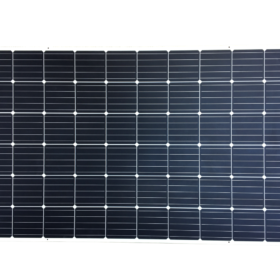
Solar module for lightweight applications from France
French manufacturer 2CA has developed a 20%-efficient solar module that weighs four times less than a glass-glass module of the same size. It claims the frameless, self-supporting panel could be used for lightweight applications at military camps and other remote locations.
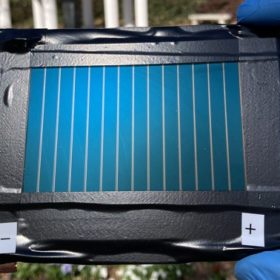
Automatically generated databases for perovskite, dye-sensitized solar cells
University of Cambridge scientists have created new databases for dye-sensitized and perovskite cells, respectively. They used the ChemDataExtractor text-mining toolkit to collect the data.

Large-area graphene-perovskite solar modules with better temperature coefficient
An Italian-Greek research group has developed a large-area perovskite solar panel with graphene-doped electron transporting layers. With increasing temperatures, the module exhibits a smaller drop in open-circuit voltage than commercially available crystalline silicon panels.
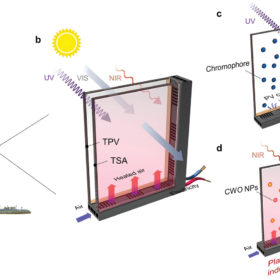
Solar window generates electricity, thermal energy
A research team in Hong Kong has built a solar window that can generate power on the external side via a luminescent solar concentrator and thermal energy on the internal side via transparent solar absorbers.
