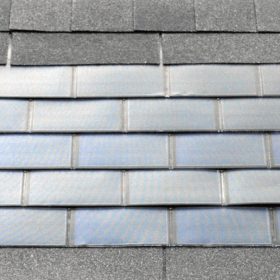
Chinese PV Industry Brief: 50 GW plan for rooftop, BIPV
Elsewhere, Wafer manufacturer Shangji Automation has secured a long-term wafer supply agreement from cell maker Aiko Solar and wafer maker Zhonghuan Semiconductor reported record revenue for 2021. Furthermore, GCL-Poly appears to have backtracked on its plan to rename the business GCL Technology
The Solar Tech Check: PV in space, and thin films stride forward
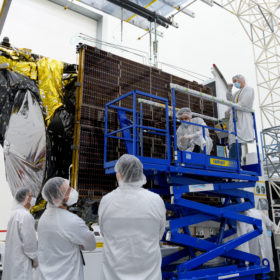
This week has seen NASA announce the completion of a new folding array set to power a mission deep into our solar system, while scientists continue to work on new applications to take such explorations even further from the sun. New measurements also promise routes to higher efficiency in cadmium-telluride PV, and details emerge of one of thinnest solar cells seen so far.

Solar caravan powering the electric vehicle that tows it
The solar modules for the solar array were supplied by Chinese manufacturer Longi, which is a major partner in the project.

Solar-plus-food in ethanol fields could fully power the United States
The conversion of the 40 million acres of ethanol corn farms in the United States into solar-plus-food facilities could generate 1.5 times the nation’s electricity needs, while also powering a 100% electrified passenger vehicle fleet.
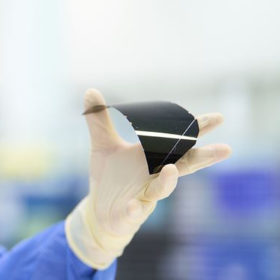
Rocket Lab unveils space solar cell with 33.3% efficiency
The new device is based on an inverted metamorphic multi-junction (IMM) cell technology developed by Rocket Lab’s unit Solaero. The cell can be used in applications in the civil, military, and commercial space markets.
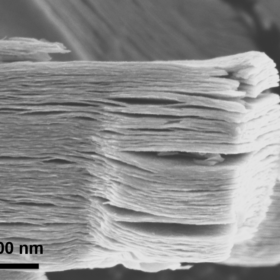
Solar cells based on 2D carbides, nitrides
Researchers from Qatar and South Korea have studied the potential of solar cells based on 2D MXenes materials. They said that titanium carbide MXene (Ti3C2Tx) is the most promising material in the MXene family for PV applications.
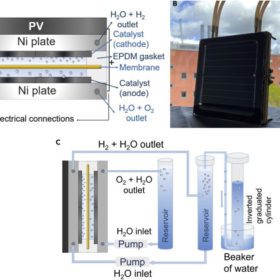
Thermally integrated PV-electrolyzer with 9.1% solar-to-hydrogen efficiency
A Swedish research group has developed a device combining CIGS thin-film solar modules and an alkaline electrolyzer based on a trimetallic cathodic catalyst made of nickel, molybdenum, and vanadium (NiMoV) and an anode made of nickel oxide (NiO). The electrolyzer achieved an average solar-to-hydrogen (STH) efficiency of 8.5% for stable operations during 100 hours.
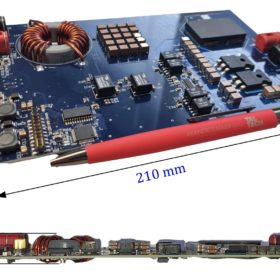
Novel power electronic converter for BIPV
Conceived by researchers in Estonia, the device is claimed to be compatible with both crystalline silicon and thin-film BIPV panels and to manage, easily, different voltage levels. It can be applied either in solar facades or BIPV rooftop arrays.
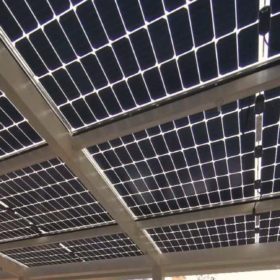
Longi releases Hi-MO 5 snow-load test results
Longi Solar has released the data of an inhomogeneous snow-load test. Its results show that its 72-cell solar modules held 1,800 pascals more force than a competing large format product using 210 mm cells.
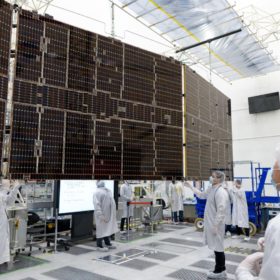
Psyche asteroid mission will be PV-powered, says NASA
NASA has said that it will explore a large, metal-rich asteroid with a remotely operated craft powered by two cross-shaped solar arrays.
