Vikram Solar plans 3 GW wafer, cell and module fab in Tamil Nadu
The engineering, procurement and construction services contractor – which has a 1.2 GW module production facility near Kolkata – will establish the factory under a five-year timescale.
Jinko claims 24.79% efficiency for n-type monocrystalline cell
The Chinese manufacturer has claimed a world record for a large-size, contact-passivated solar cell. The result, certified by Germany’s Institute for Solar Energy Research in Hamelin, betters the company’s previous record by almost 0.6%.
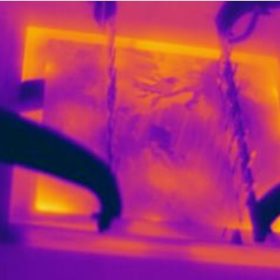
New protocols identify solar cell failures during production
Two new pass/fail protocols are said to be able to separate cells which present high hot-spot possibility, show high current leakage and demonstrate intermediate behavior. The sorting technique relies on a manual solar simulator, an infrared camera and a tool to measure isolation.
India’s ReNew Power to build 2 GW factory
The Haryana-based developer will invest up to $266.9 million to set up a new solar cell and module manufacturing facility.

Chinese PV Industry Brief: TCL acquires Zhonghuan, distributed-generation PV soars
TCL, one of China’s biggest electronics manufacturers, has acquired Zhonghuan Semiconductor. The National Energy Administration, meanwhile, reported record growth for the distributed-generation PV segment in June.

URE announces Taiwan factory disposal
The Taiwanese manufacturer said it has sold its Jhunan Kebei plant to a Taiwan-based maker of masks for semiconductor production. However, it will increase capacity at its manufacturing facility in Tainan by up to 200 MW in the third quarter.
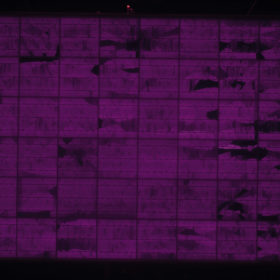
How the cracks are forming
Scientists in the United Kingdom have investigated the formation of cracks in PV cells, confirming that the high temperatures cells are exposed to during soldering for interconnection are a leading cause of cracking. Their findings will aid future research into module reliability and predictions of how cracks are likely to form.
Foil method for PID test misleading if only one side of bifacial module is stressed
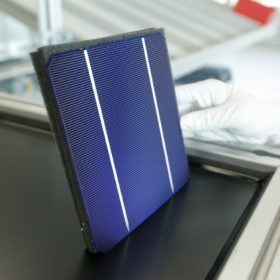
Results from PID stress tests can be misleading when bifacial PV modules are PID-stressed from just one side using the foil method in IEC TS 62804, according to a new study by Belgian researchers. An unintended electric field arises between the non-stressed side of the cell and the grounded interior of the climate chamber, which may have the undesired effect of causing additional PID stress.

Rooftop solar window based on semi-transparent perovskite solar cells
A prototype of an energy-harvesting, solar-powered smart window device has been developed by scientists from the U.S. Department of Energy’s Argonne National Laboratory. The window was created by integrating a semi-transparent perovskite solar cell and a multi-layer nanophotonic coating.
New alliance aims to break 600 W threshold
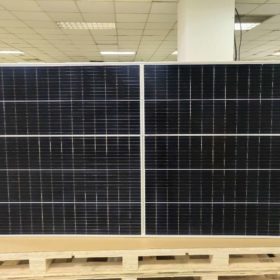
Chinese manufacturers including Trina Solar, Risen Energy and JA Solar have established a group to design and produce bigger PV modules. The 39-member alliance also includes inverter suppliers including Huawei, Sungrow and SMA.
