
Rising silver prices drive China’s Longi shift to copper-metallized solar cells
China’s Longi says it will begin mass production of base-metal PV modules in the second quarter of 2026 as rising silver prices intensify pressure to reduce metallization costs.
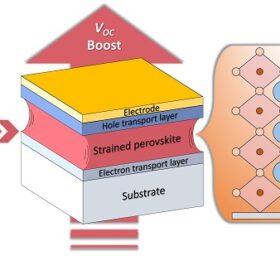
EPFL researchers enhance perovskite solar cell performance via rubidium
Researchers led by Michael Grätzel at the Ecole Polytechnique Federale de Lausanne in Switzerland have recently led efforts to improve perovskite optoelectronic properties using small-radius rubidium ion chemistry to enable more stable and efficient perovskite solar cells.
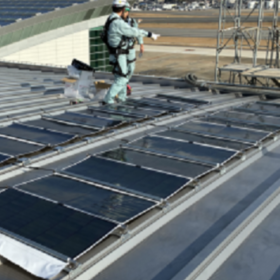
Japanese airport terminal hosting chalcopyrite solar modules
In two separate projects Japan-based Kyuden Mirai Energy and Nissan Motor are demonstrating the use of flexible, glass-free chalcopyrite PV panels provided by PXP Corporation.

Flexible front cover tested for glass-free CIGS devices
Researchers in Japan have developed an effective encapsulation with a PET front cover for copper indium gallium diselenide mini-modules. The lab devices withstood damp heat tests, retaining approximately 97 % of initial efficiency after 3,600 h.
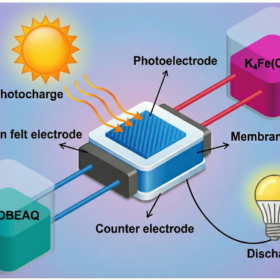
PV redox flow battery with 4.2% solar-to-electricity conversion efficiency
Scientists in China have constructed and tested a device that uses redox couples paired with a single triple-junction amorphous-silicon photoelectrode. When tested under a xenon lamp simulating one sun, the device achieved an average solar-to-electricity conversion efficiency of 4.2%.
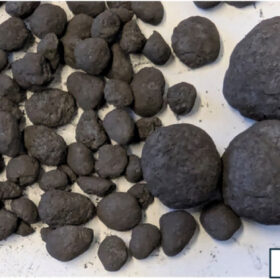
Research shows vacuum melting is key to efficient silicon kerf recycling
Researchers in Norway investigated the melting behavior of silicon kerf agglomerates under different atmospheres and temperatures to improve recycling for solar-grade silicon. They found that vacuum melting enhances deoxidation and produces a homogeneous, oxide-free melt, while agglomerate size has little effect on melting behavior.
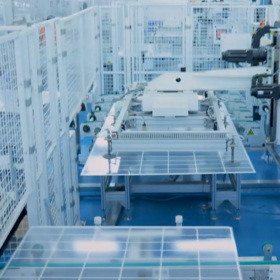
Emmvee starts production at 2.5 GW solar module line in India
With the new line becoming operational, the company’s total solar module manufacturing capacity has increased to 10.3 GW.
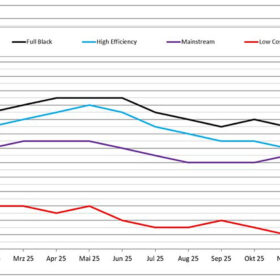
Too much to choose from, too little to decide
Market pressure in the solar and storage sectors often favors low-cost solutions, but long-term success depends on balancing price, quality, and reliability for assets designed to operate for decades. Numerous examples, from low-grade silicon modules to residential hydrogen and redox flow storage, show how technically ambitious products can fail when costs, complexity, or durability are misjudged.

Building resilience amid intensifying weather events
In its latest monthly column for pv magazine, IEA PVPS shows that with climate-specific site selection, robust design, proper installation, and proactive O&M, most PV systems can be made resilient and remain reliable despite intensifying weather risks.

Eni, FuturaSun set up startup for perovskite-silicon tandem module production
Italian energy group Eni and solar manufacturer FuturaSun have launched SunXT, a new startup focused on developing and producing perovskite-silicon tandem solar modules, building on FuturaSun’s research expertise.
