
India tenders for another 1.2 GW of solar capacity
Bidders can pitch for up to 300 MW of generation capacity per project with the deadline for proposals on February 4. The eighth tranche of inter-state transmission system program capacity offered by the Solar Energy Corporation of India comes with an energy price ceiling of $0.039/kWh.

Saudi Arabia launches 1.2 GW solar tender
With the third procurement round of the kingdom’s National Renewable Energy Program, the Renewable Energy Project Development Office is tendering four large-scale solar projects. Successful bidders will have to include at least 17% local content in their facilities.

Putting the strain into engineering a more stable perovskite
U.S. researchers claim to have improved the stability of one of the most promising halide perovskites – α-FAPbI3 – by squeezing the compound’s crystal lattices. The authors of the research prevented the crystal assuming an hexagonal shape at the room temperatures required for a PV device to operate properly.
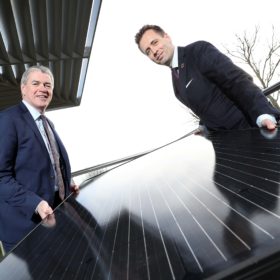
Ireland set for a 500 MW, five-year solar pipeline
Danish developer Obton and Ireland’s Shannon Energy have promised to develop the projects within five years. Total investment is expected to be around €300 million and the companies have already acquired projects with a combined generation capacity of 150 MW.
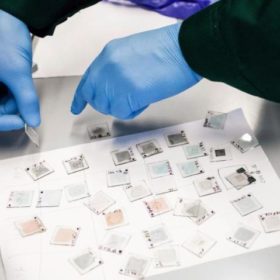
Japanese manufacturer acquires rights to produce 23.26% efficient CIGS perovskite cell developed by HZB and Kaunas University
The research group that developed the cell said the two materials used to produce it, dubbed 2PACz and MeO-2PACz, will soon be commercially available. The material consists of 1-2nm of self-assembled monolayers deposited on the surface of the perovskite by dipping it into a diluted solution.
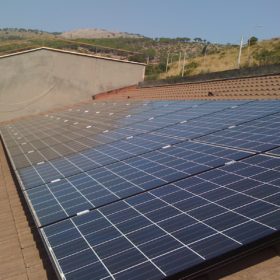
Italy rebalances PV market
The government has abrogated a controversial measure introduced last year which favored big developers in the allocation of fiscal incentives for rooftop projects linked to building renovation.

A new perovskite material for solar applications
Barium zirconium sulfide is another chalcogenide perovskite being tested in relation to the development of more efficient solar cells. Researchers at Buffalo University, in New York state, have created a thin-film based on the material they say offers significant light absorption and good charge transport.

EDF seeks mounting structure providers
The renewable energy unit of the French energy giant has made a public call to source mounting structures for the large scale PV projects it wants to build in France up to 2023.
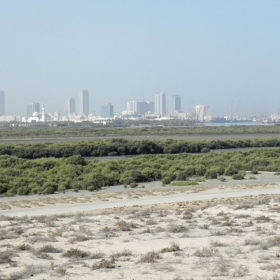
Emirate of Umm al-Quwain launches tender for 500 MW solar park
The UAE Federal Electricity and Water Authority is seeking expressions of interest to enable it to pre-select independent power producers for the project. The plant will be owned 60% by the government of Umm al-Quwain and the electricity authority, with the successful developer owning the balance.
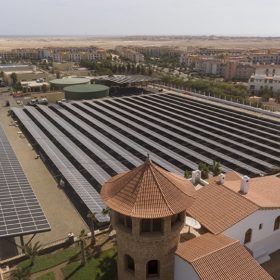
Cape Verde kicks off 10 MW solar tender
The Ministry of Industry, Trade and Energy has issued an expression of interest to pre-qualify developers for two 5 MW solar plants. The facilities will be on the islands of Sal and São Vicente.
