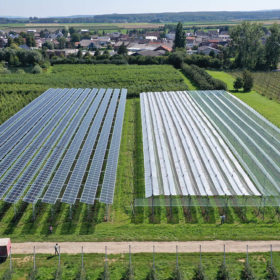
Using agrivoltaics on 1% of EU farmland could lead to 944 GW installed capacity, JRC says
If 157,621 hectares of utilized agricultural area in the European Union incorporated agrivoltaics, it could produce up to 944 GW installed capacity, a new study published by the Joint Research Centre found. Despite the optimism, certain challenges – such as no clear definition and dedicated standards – stand in the way of the technology’s success.
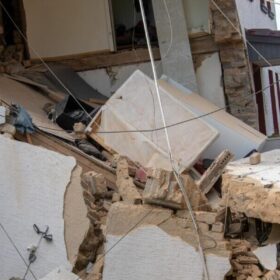
German home destroyed by 30 kWh battery explosion
The German authorities have attributed the recent explosion of a 30 kWh storage battery in a private home to a likely technical defect. The incident has left the home uninhabitable, and property damages will likely be substantial, according to investigators.
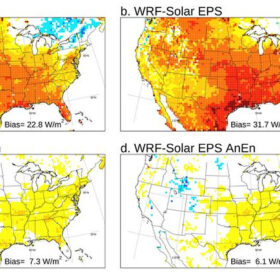
New research points to WRF-Solar forecast shortcomings
A research team in China assessed the accuracy of the WRF-Solar numerical weather prediction model in simulating global and diffuse radiation. The group’s work highlighted the model’s sensitivity to aerosol optical depth, cloud optical thickness, and solar zenith angle.

Qcells fully acquires intellectual property rights for LECO tech
Qcells has acquired full ownership of intellectual property rights for LECO technology with the recent acquisition of Cell Engineering. The technology is known to enhance the efficiency of PERC and TOPCon solar cells.
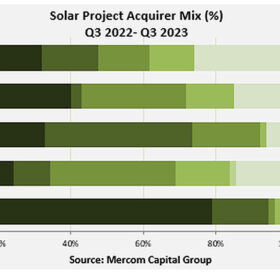
Solar sector corporate financing up 55% so far this year, Mercom says
Despite inflationary challenges and elevated interest rates, financing in the solar industry has remained robust with corporate financing sitting at $28.9 billion – a 55% hike from last year’s $18.7 billion, a new report by Mercom Capital Group states.
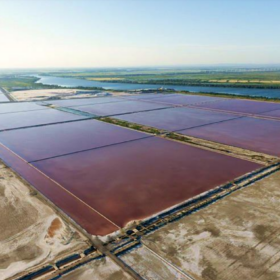
Compagnie Nationale du Rhône to install 100 MW of solar on salt marshes
Salins group, the leading salt producer in France, has joined forces with Compagnie Nationale du Rhône and its subsidiary, Vensolair, to build 100 MW of solar on unused salt marshes in southern France. The two companies say they might also build experimental projects on operational salt production sites.
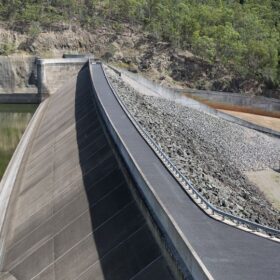
Australian hydropower company begins work on 2 GW pumped hydro project
Exploratory work and detailed site investigations have started for the 2 GW Borumba Dam pumped hydro project in Queensland, Australia.
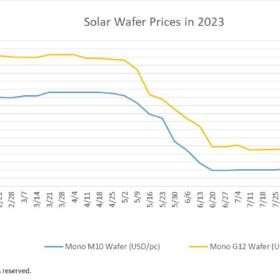
Solar wafer prices hit record lows
In a new weekly update for pv magazine, OPIS, a Dow Jones company, provides a quick look at the main price trends in the global PV industry.
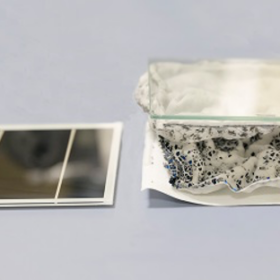
France’s CEA developing tech to recover silicon, silver from end-of-life PV panels
The French Alternative Energies and Atomic Energy Commission (CEA) has developed a recycling process for end-of-life PV modules, recovering silicon and silver, using supercritical CO2. Virginie Basini, head of CEA’s sustainable technologies department, discussed the technique with pv magazine France.
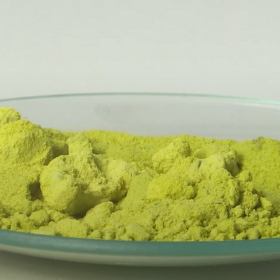
Bismuth ferrite, tungsten trioxide thin films for PV cells
Researchers recently identified the optimal laser energy for crafting BFO/WO3 bilayer thin films for solar cells at 200 millijoules (mJ), by carefully considering factors such as leakage and band gap.
