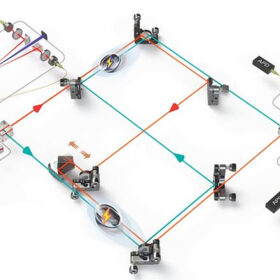
Charging quantum batteries
Researchers in Japan have taken advantage of an unintuitive quantum process that disregards the conventional notion of causality to improve the performance of so-called “quantum batteries.” They believe these advances could help to bring the technology a little closer to reality.
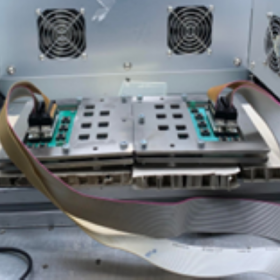
MXenes-based organic solar cells offer greater stability, claim scientists
An international research team claims to have achieved greater stability in organic solar cells made with an electron transport layer doped with two-dimensional titanium carbide (Ti3C2Tx) – also known as “2D MXenes.” They used green solvents and an MXenes material known as titanium carbide (Ti3C2Tx).

Red Solar claims 26.01% efficiency for TOPCon bifacial solar cell
Chinese manufacturer Red Solar says its new 182 mm bifacial solar cell, which is based on tunnel oxide passivated contact (TOPCon) tech, has an efficiency of 26.01%.
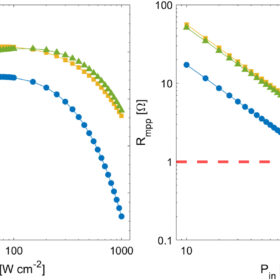
Optical photovoltaic converters for power transmission systems
Researchers from Spain have developed a novel model to evaluate optical photovoltaic converters used in high-power optical transmission. They have found that indium gallium nitride (InGaN) and indium aluminum nitride (InAlN) semiconductors could provide better results than gallium arsenide (GaAs).

Vaysunic launches hybrid photovoltaic water heater
The Chinese manufacturer says that its new V series heaters can use either PV or AC grid power. It can also be controlled and monitored via WiFi.

How to integrate residential solar-plus-storage with vehicle-to-home systems
Researchers from Australia have created a model to optimize the interaction between vehicle-to-home (V2H) systems and residential PV connected to battery storage. They claim V2H can help reduce the cost of energy by 16.7% for workplace charging and 25% for public charging.
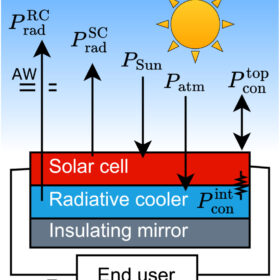
New research shows potential of solar cells based on cement radiative coolers
Researchers in Italy have proposed the use of radiative coolers made of cementitious materials to reduce the operating temperature of solar panels. They incorporated Auger (AUG) and Shockley–Read–Hall (SRH) nonradiative recombination into their modeling and described the practical realization of the coolers as “attractive.”

Denmark supports first energy communities
The Danish Energy Agency says it dished out a total of DKK 4.2 million ($61,9542) in grant funding this year to nine local energy communities and projects supporting renewable energy. Projects include an energy community start-up guide for rural environmentalists to an energy community feasibility study in a decades-old garden association.

RenewSys launches encapsulant for n-type TOPCon solar cells
RenewSys says its Conserv E–NT polyolefin elastomer (POE) encapsulant is specially designed to prevent the degradation of n-type TOPCon solar modules in the field.

Vaysunic releases new microinverters
Chinese manufacturer Vaysunic New Energy has developed eight versions of its VM microinverters. Their AC output power ranges from 600 W to 1,000 W.
