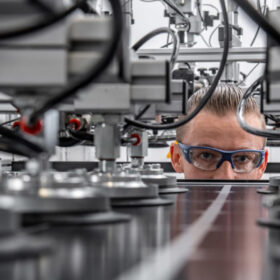
We need a ‘Domestic Renewable Energy Production’ standard for PV installations in Europe
The threat of catastrophic climate change, as well as increasingly obvious economic benefits, make it advisable, indeed essential, to convert our entire energy system to a sustainable system, based on renewable energy (RE) as soon as possible. The two main pillars of our future RE-based energy system will be power generation from PV and wind. In Germany alone, according to detailed studies by Fraunhofer-Institut für Solare Energiesysteme ISE, we will need at least about 300 GW of PV and an equally large amount of wind power.
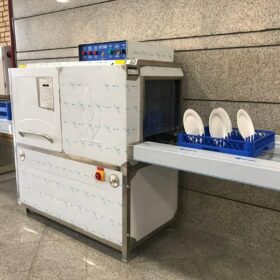
Using air conditioning to cool down PV modules, dry dishes
An international research team has investigated how air conditioning may be used to reduce the operating temperature of PV panels. The researchers not only found that the proposed approach is technically viable, but they also tested the use of excess heat from the panels for drying dishes.
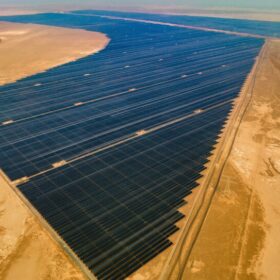
EWEC commissions 2 GW solar plant in Abu Dhabi
Abu Dhabi government officials last week inaugurated the 2 GW Dhafra Solar Photovoltaic Independent Power Project, located roughly 35 kilometers from United Arab Emirates’ capital. The plant consists of four million bifacial solar panels and is claimed to be the world’s largest single-site solar power plant.
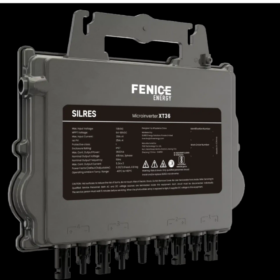
Fenice Energy unveils microinverters for high-power solar panels
Fenice Energy, formerly SunEdison, has developed single-phase and three-phase microinverters for residential and commercial solar installations. The microinverters support up to 670 Wp+ PV modules, with a maximum input current of 20 A.
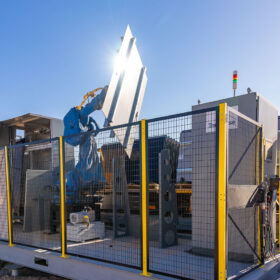
Watch: Robots install solar project in Arizona desert
In its first commercial project, Terabase Energy successfully installed 17 MW of a 225 MW solar facility with its automated Terafab platform.
Hithium, Solarpro to build 55 MWh energy storage facility in Bulgaria
Hithium and Solarpro say they will start construction on a 55 MWh energy storage facility in southwestern Bulgaria next year.
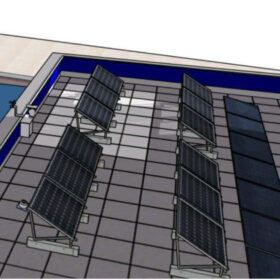
‘Cool roofs’ increase power yield in bifacial rooftop PV systems
A Spanish-Algerian reserch group has tested how “cool roofs” could help increase power yield in rootop bifacial PV systems. Cool roofs are based on coating materials with high reflectance properties.

Sweden’s Epishine expands indoor PV module manufacturing capacity
Epishine, an organic PV module manufacturer, has completed a new factory in Linköping, Sweden. The facility uses roll-to-roll equipment to produce new products for low-power battery replacement and the self-powered electronics market.

Kesterite solar cell achieves 12.01% efficiency via selenization approach
The Chinese Academy of Sciences (CAS) has used a new selenization approach to build a kesterite solar cell with better charge transport and power conversion efficiency. China’s National PV Industry Metrology and Testing Center (NPVM) has certified the results.

BP advances 100 MW green hydrogen project in Australia
BP will look at deploying a 100 MW electrolyser to produce renewable hydrogen for Australia and export markets. It aims to transform its former Kwinana oil refinery site in Western Australia into a green fuels hub.
