
Eni, FuturaSun set up startup for perovskite-silicon tandem module production
Italian energy group Eni and solar manufacturer FuturaSun have launched SunXT, a new startup focused on developing and producing perovskite-silicon tandem solar modules, building on FuturaSun’s research expertise.

Using horizontally connected salt caverns for compressed air storage
Researchers in China have investigated the long-term stability of horizontally connected salt caverns used for compressed air energy storage. They found about 85% of the existing salt caverns in their home country are are suitable for this configuration.

Imaging tech to analyze sub-cells in tandem and triple junction PV devices
A team at Fraunhofer ISE has created new imaging methods to measure losses in individual sub-cells of multi-junction solar cells based on perovskite-silicon and perovskite-perovskite-silicon combinations.
Slovak researchers predict PV inverter output without weather sensors
Researchers in Slovakia have demonstrated a machine-learning framework that predicts PV inverter output and detects anomalies using only electrical and temporal data, achieving 100% accuracy in classifying inverter output states under static operating conditions at a solar installation.
China’s first polysilicon consolidation steps unlikely to move prices in Q1
China’s largest polysilicon producers have launched initial steps toward consolidation to curb overcapacity, but OPIS analyst Summer Zhang tells pv magazine that unresolved funding, capacity cuts and governance issues mean prices are likely to see only modest support in the near term without sustained capital injections and stronger downstream demand.
Aiko achieves 24.8% efficiency in commercial solar module production
The result concerns the company’s Comet 3N modules and has been confirmed by TÜV Nord in Germany.

Ambrion launches new all-in-one storage solutions
The Australian firm has introduced single-phase 5 kW and 6 kW AC output storage systems, as well as three-phase 10 kW and 12 kW models. Storage capacities of the new products range from 5 kWh to 40 kWh.
Rooftop bifacial PV can produce over 9% more power than monofacial systems in high-latitudes
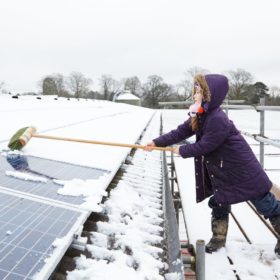
A study analyzing urban bifacial PV systems in high-latitude areas found they can generate 9–13% more electricity than monofacial panels under snow conditions, particularly in winter, while also achieving a lower levelized cost of electricity. The research developed a techno-economic optimization model considering snow effects, panel orientation, interrow spacing, and operation modes, highlighting sensitivity to market conditions and discount rates.
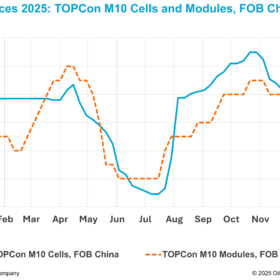
China TOPCon cell prices dip despite looming cost pressures
In a new weekly update for pv magazine, OPIS, a Dow Jones company, provides a quick look at the main price trends in the global PV industry.

Clivet releases residential air-to-air heat pump
The Italian manufacturer said its new Fullness heat pump system has a coefficient of performance of 2.8 and a seasonal energy efficiency ratio of 3.79.
