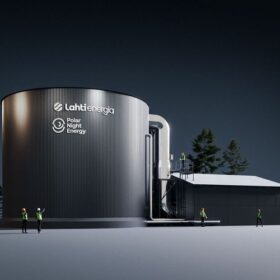
Finland’s Polar Night to build 250 MWh sand battery for district heating provider
Only months after inaugurating the world’s largest sand battery – a 1 MW/100 MWh thermal storage system – Polar Night has committed to building a project twice its size.
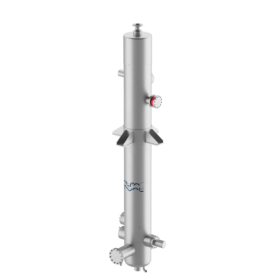
Alfa Laval launches once-through steam generator for thermal storage
The Swedish company stated that its new product was designed for use in compact, molten salt energy storage applications, eventually in combination with PV power. In its standard configuration, it can reportedly withstand temperatures up to 400 C and pressures up to 60 bar.

Thermal storage beats hydrogen, electrification on industrial costs
A new study in Germany shows the advantages of thermal energy storage in the decarbonization of industrial processes. The researchers noted clear cost advantages and high potential for flexibility in the power grid.
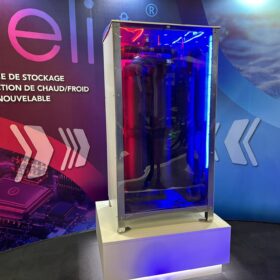
FHE Group presents thermal battery for solar power storage
The French company says its Inelio thermal battery can store solar power in the form of heat for heating and cooling applications, as well as for producing domestic hot water, while maximizing self-consumption. It can reportedly provide a hot water temperature of up to 65 C.
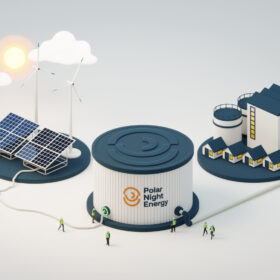
Testing to start on 100 MWh sand-based thermal battery in Finland
Finnish startup Polar Night Energy is building an industrial-scale thermal energy storage system in southern Finland. The 100-hour, sand-based storage system will use crushed soapstone, a by-product from a fireplace manufacturer, as its storage medium.

China State Grid unit completes first phase of 1 GW solar-thermal project
State Grid Turpan Power Supply Co. says it has completed the first phase of a 1 GW hybrid solar-thermal energy storage project in western China. It is set to generate more than 2,000 GWh per year.
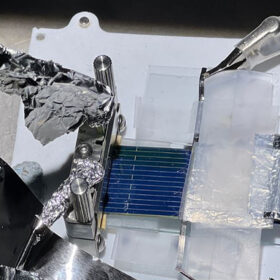
PV cell integrating molecular thermal storage tech achieves 14.9% solar utilization efficiency
Scientists in Sweden have integrated a PV device with a molecular solar thermal (MOST) energy storage system, which acts as as a solar cell optical filter and cooling agent. The proposed combination achieves a 0.2% higher PV efficiency and solar storage efficiency of 2.3%.
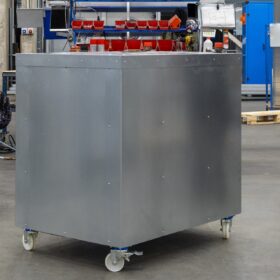
Hungarian startup offers PCM-based thermal battery with energy density of 30 kWh/m3
Hungary-based Heatventors is offering its new thermal energy storage system with capacities of 10 kWh, 30 kWh, and 60 kWh. The thermal battery is combinable with solar PV and has an expected service life of over 10,000 cycles.

Thermal energy storage tech to bolster industry decarbonisation
Long duration energy storage developer MGA Thermal is one step closer to commissioning its behind-the-meter demonstration plant after receiving a $2.48 million windfall from the Australian Renewable Energy Agency.
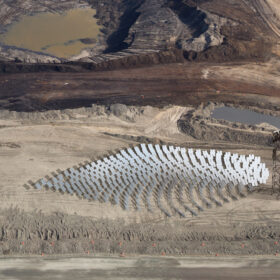
Making the case for concentrated solar power
Dismissed by many in the solar industry as an overly-complex, outdated technology, concentrated solar power (CSP) is set for a comeback thanks to a scaled-down, modular approach.
