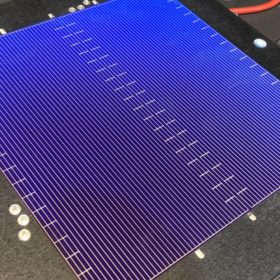
How LECO process could push TOPCon solar cell efficiency beyond 26%
A new UNSW study shows that laser-enhanced contact optimization (LECO) can boost industrial TOPCon solar cell efficiency by improving contact properties and reducing recombination losses. By combining optimized firing conditions with LECO “repair” of contacts, the approach balances recombination and resistance, offering a practical path for conventional TOPCon cells to compete with PV technologies offering higher efficiencies.
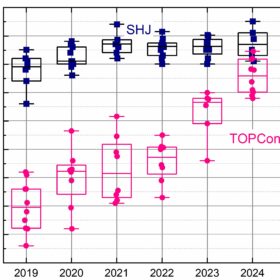
Heterojunction vs. TOPCon in perovskite-silicon tandem
Scientists in Australia claim that TOPCon cells are rapidly closing the open-circuit voltage gap with heterojunction counterparts, now under 10 mV, while offering greater wafer tolerance and high industrial scalability. Despite slightly lower efficiency, TOPCon-based perovskite/silicon tandems can achieve a levelized cost of energy comparable to heterojunction-based tandems due to reduced fabrication costs, according to the researchers.
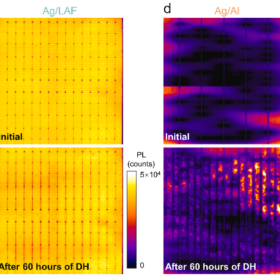
UNSW unveils new ageing method to assess TOPCon solar module degradation
UNSW researchers developed a chemically selective, nitrate-based, single-sided accelerated ageing method for TOPCon solar cells that replicates the mildly acidic environment inside EVA-encapsulated modules. The proposed approach enables rapid, physically meaningful screening of front-side metallisation stability, reliably predicting module-level degradation and reducing development time and costs, according to its creators.

NREL researchers quantify UV-induced degradation levels in TOPCon solar cells
Researchers at NREL found that UV exposure can cause significant, partly non-recoverable degradation in TOPCon solar cells, with strong cell-to-cell and intra-cell variability linked to passivation and processing inconsistencies. While some UV-related losses recover quickly under light and are unlikely to affect field performance, the findings highlight gaps in current qualification tests and the need for improved UV aging standards.
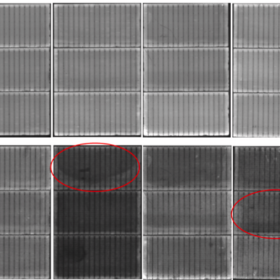
UNSW researchers identify new damp heat-induced failure mechanism in TOPCon solar modules
UNSW researchers identified a new damp-heat degradation mechanism in TOPCon modules with laser-fired contacts, driven primarily by rear-side recombination and open-circuit voltage loss rather than series-resistance increase. The study highlights that magnesium in white EVA encapsulants accelerates degradation, guiding improved encapsulant and backsheet selection for more reliable modules in humid environments.
Localized polysilicon thinning improves TOPCon solar cell performance
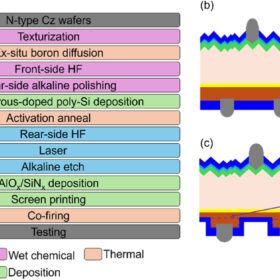
UNSW researchers boosted TOPCon solar cell efficiency by locally thinning the rear poly-Si layer, reducing parasitic absorption while preserving wafer integrity. The champion cell built with this approach achieved 25.10% efficiency with improved bifaciality and maintained strong passivation.
Thicker alumunium oxide layers can reduce ultraviolet-induced degradation in TOPCon solar cells
UNSW researchers developed an experimentally validated model linking UV-induced degradation in TOPCon solar cells to hydrogen transport, charge trapping, and permanent structural changes in the passivation stack. They show that thicker aluminum oxide layers significantly improve UV resilience by limiting hydrogen migration, offering clear guidance for more robust TOPCon designs.

The impact of laser-assisted firing on TOPCon solar cell performance
UNSW and Jolywood studied the thermal stability of laser-assisted fired TOPCon solar cells during module fabrication and high-temperature stress, identifying hydrogen-related defect dynamics as the key factor behind degradation and recovery. They found lamination causes temporary efficiency losses that self-recover under light exposure, while optimized LAF can restore degraded contacts, providing practical guidance for reliable module manufacturing and testing.
JinkoSolar achieves world record efficiency of 27.79% for TOPCon solar cell
The Chinese manufacturer says Germany’s Institute for Solar Energy Research Hamelin (ISFH) has independently verified the result.

Toyo strikes solar cell supply deal with Voltec Solar
Japanese TOPCon specialists Toyo will become the official solar cell supplier of French solar panel manufacturer Voltec Solar, following the signing of a strategic partnership that marks Toyo’s first entry into the European market.
